Monday, August 15, 2011

Rave On

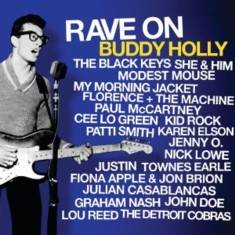
Two new cds getting lots of play at The Oz Mix headquarters are Rise Again by Lee Scratch Perry, and surprisingly, the recent tribute to the songs of Buddy Holly called Rave On.


I'll talk about Rise Again soon, in a future post, but first I have to rave on about Rave On. I wasn't expecting to like this album as much as I do. Outstanding soulful performances, interesting new arrangements sometimes very different than the original, and best of all, excellent, often out-of-the-box audio production.

The highlight for me has to be Paul McCartney's two versions of It's So Easy. One version sounds like a raucous garage band reinventing the passion of rocking out for the first time, vitally fresh and alive. The production is exquisitely raw and down to earth - a tastefully distorted lead vocal compels McCartney's powerful delivery that gives the feeling of someone pulling out all the stops to communicate their truth. The gorgeously over-compressed drum sound squishily keeps a smoothly rolling rhythmic chug with cymbal splashes sustaining forever. This drum sound makes a big contribution to the contemporary/retro atmosphere of the track.

I once joked about writing an academic paper on the different types, uses and abuses of compression in audio mixing. Over-compression can choke a sound much easier than it can create an interesting new texture. It's a fine and delicate art getting interesting sounds with extreme compression. The It's So Easy drum sound would be one model example if I get around to writing that paper. If I had to guess, I'd say they used vintage API 525 compressors which can do magick things to a drum beat. This track, produced and engineered by David Kahne, was recorded at Avatar in New York. Avatar used to be the Power Station, and still sounds like one of the top studios in the world.

Rave On, in particular the garage version of It's So Easy makes a great soundtrack to everything I've been writing about Qabalah.

Recently I saw a documentary on comedian Bill Hicks, someone largely off my radar until now. There was one clip where Hicks bemoaned the state of music and expressed, in a very catharic fashion, the kind of music he'd prefer to hear. I wish he was still alive to hear Rave On because it fully meets his criteria.

I found the same clip on YouTube. Warning: it's quite intense. I completely disagree with the Amy Winehouse spin imposed on it. I don't believe Hicks was being literal when calling for death.


When he rants: "I want them to play with one hand, and the other on a gun (pointing to his head) ..., " it gives a graphic variation on Crowley's instruction to "Slay mind" from the Lambskin poem a few posts back.

A number of other tracks from Rave On exude the same kind of passion but with a more elegant aesthetic. Patti Smith's version of Words of Love is another favorite from this collection. Critic David Fricke from Rolling Stone called it a 'precious wish.' Fiona Apple and Jon Brion do a superbly intimate version of Everyday. Florence + the Machine play a unique version of Not Fade Away that evokes the mood of a New Orleans street band on a joyful funeral march. All of the tracks are well done and worth listening to.

This recording highlights the brilliance of Buddy Holly's songwriting, something I didn't fully appreciate until now.


Sunday, August 14, 2011

Keep the Lasagna Flying

Sometimes you'll hear the 'selective perception' objection made against the active qabalist. Selective perception, in this context, means that certain numbers appear more because you're either subconsciously looking for them, or you're selectively choosing to perceive those numbers while ignoring others. You see your key numbers more only because you have given them special significance. They stand out more but don't really occur more than any other number randomly would, according to this argument.

The point is valid to some degree. Self deception is easy, and we make up meaning and significance all the time. I can recall two films where the protagonists had a severe form of this which lead to obsession, A Beautiful Mind, the Russell Crowe film based on a true story, and π or Pi.

This only affirms Qabalah as a powerful and effective tool for altering consciousness. The fact that tools can get abused doesn't mean that the tool is imaginary or universally harmful and can't be utilized with intelligence and common sense. Non-judgmental self-observation is one preventative remedy against psychological imbalance.

Certain numbers may take on extraordinary significance to you as a result of mind-blowing synchronicities ( meaningful coincidences), to use a technical term. If a number comes to your attention through one or more startling coincidences and you don't take notice, then you appear to be either uninterested in learning more about yourself and the Universe through Qabalah or are just generally occluded to accept the possibility of anything outside what you've been told is real.

There's a line from the film, Beetlejuice, that goes something like, "the living won't see the dead, not can't, but won't." Understood metaphorically, this could mean that "the living" - those who have never undergone or don't remember any kind of ego death, the unwashed masses as it were, won't see "the dead" ie the Bardo, the magickal world where change occurs. Not can't, but won't.

By the way, Beetlejuice, contains multiple levels of qabalistic symbolism. It's considered a textbook study for bardo information and functioning whether seen through the macroscope of qabalah or not.

However, this is all beside the point I've been making, that Qabalah is a higher order language useful for transformation. The proof of this is in the writings of authors who use Qabalah, as well as the fact that this language has dictionaries for it.

It's not necessary to receive numbers through strange circumstances to observe that some numbers have been given prominent attention. Perhaps the most well known of these in this cultural enclave is the "23 Conspiracy" presented in Robert Anton Wilson's Cosmic Trigger Volume I which he first heard from William Burroughs. Anyone who believes that Wilson was merely sounding off on an obsession he selectively afflicted himself with is missing a valuable lesson. 23 does have a connection with a particular archetype quite discernible by looking it up in 777 (don't forget to check the list of primes) or by reading Cosmic Trigger. Anyone care to say what I'm getting at?

Earlier I made the argument that Wilson also highlighted the number 68, though he did so mainly in a qabalistic fashion, not directly like he did with 23, except for the direct mention of 68 on the first page of Illuminatus! 68 is the second number given in Illluminatus! right behind the number 1. This makes sense because the first chapter is called The First Trip, or Kether which is the first Sephiroth on the Tree of Life.

I forgot to mention another strong allusion Wilson made to the ideogram represented by 68. Shortly before he died Wilson wrote his last public statement on a blog and signed off with the whimsical instruction to "keep the lasagna flying."

Now if this flying lasagna is as good as my father's homemade recipe or any other genuine Italian cook, it's not much of a stretch to consider it heavenly food. Heavenly food is also known as manna. Manna is the title of chapter 68 from Crowley's Book of Lies, a qabalistic touchstone.

Was Wilson communicating something along the lines of summing up his life's work and the continuation of it, or was he being merely whimsical? Perhaps it was a Discordian attempt to promote harmless anarchy, or maybe he meant to support the lasagna economy with increased sales? Could it be some combination of all of these or for a whole other unknown reason. Any thoughts?


Friday, August 12, 2011

Beliefs Unlimited

To clarify something in the previous post - when I said it was easy to temporarily get out of limiting belief systems, I meant it seems easy to temporarily quiet the ego and habitual mind enough for the purpose of getting on with the experiment. In general, it doesn't seem easy at all to change deeply ingrained programming and strongly held belief systems about who we are and what we can do, but it is possible, even probable when one actively embarks upon the course.

One method I'd like to present is Beliefs Unlimited, a meta-programming (programming your programs) technique designed by Dr. John Lilly, one of the greatest visionary scientists of the XXth Century. Lilly was a pioneer in the research of dolphin intelligence, and was the inventor of the floatation tank.

Beliefs Unlimited Exercise

This exercise is useful when one attempts to move beyond one's current belief
structures. Record the the following in a soothing and authoritative manner
five times into a tape recorder.

(start of belief unlimited tape)

In the province of the mind, what one believes to be true either is true or
becomes true within certain limits, to be found experientially and
experimentally. These limits are beliefs to be transcended.

Hidden from one's self is a covert set of beliefs that control one's thinking,
one's actions, and one's feelings. The covert set of hidden beliefs is the
limiting set of beliefs to be transcended. To transcend one's limiting set, one
establishes an open-ended set of beliefs about the unknown.

I quoted the first couple of paragraphs because it seems to sum up the situation. The whole exercise is highly recommended by me. A free pdf can be downloaded HERE.

It's very short, only 10 paragraphs, and like it says, is meant to be recorded 5 times. The instructions before the start of the tape and below can be modified as desired. I made one recording where the effects - flange, delays and reverb - got progressively stronger with each cycle.

(from The centre of the cyclone an autobiography of inner space by John C.
Lilly,M.D.)
When listening to the tape, lie in a comfortable position on the floor with the
lights very dim and just allow the words and meaning enter you without any
resistance.

I tried it maybe a dozen to 20 times in various modes of "imprint vulnerability" - greatly aided by a floatation tank. Not that I couldn't benefit from doing it more. I probably will.

Note that when Lilly writes, "To transcend one's limiting set, one establishes an open-ended set of beliefs about the unknown," he doesn't give any indication of what those open-ended beliefs should be. That's all up to you. I also find it significant that he suggests a "set of beliefs" rather than "a belief" about the unknown.

I remember Lee Perry, of the Samadhi Tank Company, telling me that John told them when giving orientations to first time users of the floatation tank to take extreme care to NOT give them any kind of programming or suggestions about HOW to use the tank, what to do or expect in there.


Wednesday, August 10, 2011

Arcana addendum

Forgot to point out that Lambskin also finishes with

Tyle!
Cowan, Skidoo!

It ends the way it started, and starts the way it ends.

Skidoo = Get Out = a banishing.

Starting with a banishing and closing with another banishing follows the same form as a magical ritual or service. In magick, the first banishing is meant to clear and cleanse the space of any inner or outer distractions so that the focus can be on the intention of the operation. The final banishing is actually meant to banish the space of the ritual, to return to common place, everyday, knock on wood reality.

This is why it's really rather easy to Get Out of personality, ego, and limiting belief systems because you know that it's only for a set period of time, and for a specific purpose. You also know that a very necessary part of closing the Experiment will be to banish that Alternate Reality and return to (take rebirth in) the comfort zone of material reality - what Qabalists call Malkuth - perhaps a little wiser for the experience.

Musicians who are making music, not generating sound vibration cliche, do this all the time when they play. They instinctively understand that it's ok to take their music where it wants to go because it's only for an agreed upon period of time.

The second banishing makes it ok for skeptics to temporarily drop their skepticism if they wish for a taste of gnosis themselves instead of remaining only skeptical of it. Gnosis doesn't establish certainty but it does make a convincing case against absolute skepticism of anything outside what we already know about the so-called laws of nature.

Balanced skepticism appears invaluable and essential for keeping one psychologically centered and grounded. Robert Anton Wilson's Cosmic Trigger Volume I is the best example I know of in print of someone with this kind of critical skepticism balanced against great flexibility with temporarily dropping skepticism for gnostic experiments.

Tuesday, August 9, 2011

Arcana


LJ commenting on the Lambskin ( ch 38 of The Book of Lies) post said...

The Book of Lies is one of AC's more interesting books, but fairly obscure to me.

Cowan--'One who does the work of a mason, but has not been apprenticed to the trade. 2. Hence, One uninitiated in the secrets of Freemasonry 1707. 3. slang. A sneak, eavesdropper.'

http://www.masonicworld.com/education/files/dec04/cowan.htm

I suppose the first line means, 'Get lost, uninitiated!' or something along those lines.

I can't find 'Tyle' but the word 'Tyler' is the outer guard of a masonic lodge, but that may not be relevant.

Thank-you for this valuable research, LJ. It highlights a point previously unknown to me in that poem, but very related to what I've been getting at - that anyone can do the "work" that's been suggested in the past few posts from (to borrow a memorable phrase from William Burroughs and Robert Anton Wilson) 'right where you are sitting now.' Meaning that no special training is required. No particular ideology needs to be subscribed to or believed in. Nothing to buy or sign up for. You don't have to wait until you're ready.

This applies to everything that's been presented here about the technology of bardo readings - what Tibetans call the Power of Liberation by Sound - from doing a formal reading from the American Book of the Dead to singing a song for someone. From reciting the opening page of Finnegans Wake to inspire and invigorate a drum solo recording ( I saw a drummer named Skip Reed do this at a session for The Laughing Dogs - he recited it from memory) to listening to the Bill Laswell/Tony Williams collaboration, ARCANA: Arc of the Testimony with expansively directed attention.


The poem (or qabalistic koan, if you like) Lambskin starts out:

Cowan, skidoo!
Tyle!

My interpretation of Cowan leans more to the first definition LJ provided above: 'One who does the work of a mason but hasn't been apprenticed to the trade. ' The other definitions apply as well because we have multiple meanings here.

Skidoo is the title of chapter 23 from The Book of Lies. The formula there is, Get OUT.

Therefore the first line could read as: "Uninitiated, or beginner, get OUT!

Two meanings, opposite to each other, suggest themselves. The obvious one - a literal warning to be taken seriously, and the one Crowley gives as a magical formula which, on the most basic level, means to transcend your fundamental preconceptions about what is real and what is possible. Or to just simply get out of personality, get out of ego as a precursor for entering the temple. That's all the uninitiated need do to begin. By the way, this is but the tip of the iceberg to this formula/banishing, get out, as further study and practice will certainly reveal.

Tyler ( one who Tyles) has this definition in A.E. Waites', A New Encyclopedia of Freemasonry:

- The Officer in charge on the further side of the Lodge-door. When he and the Officer on the hither side are on active service the Lodge is tyled. He is called Janitor in the Royal Arch and Guard or Sentinel in some other Degrees.

Well, that's as far as I'll go. After all, the back cover of The Book of Lies warns:

THE BOOK OF LIES is a witty, instructive, and admirable collection of paradoxes; however, it is not a philosophical or mystical treatise. Actually, its subtleties exhilarate. Scholars have said it is "stupendously idiotic and amazingly clever." To endeavor to translate it into definite terms Crowley's aphorisms would detract from the value of the book. It is wiser for readers to make their own interpretation.


Sunday, August 7, 2011

Toshinori Kondo - Blow The Earth

Toshinori Kondo is one of the world's top players of the electric trumpet. I've had the great fortune of knowing and working with him since about 1991 when I went to Japan with Bill Laswell to mix the Front of House at the festival Kondo organized in his hometown, Imabari. We also recorded an improvised album at Kondo's studio, Metal Box, on the same trip called, The Map Is Not the Territory. It features an incredible line-up of musicians. Along with Kondo and Laswell it includes Ginger Baker, Anton Fier, Yamaki, Foday Musa Suso, Akira Sakata, and Peter Brotzmann among others. This collective became known as Autonomous Zone a name derived from Hakim Bey's radical manifesto, Temporary Autonomous Zone. Kondo began his Blow The Earth project playing solo against the backdrop of Israel's Negev Desert in 1993. 


I recently saw the dvd for his Blow The Earth Japan segment in which he "played the four seasons of Japanese nature." About Blow The Earth Kondo says: I wanted to improvise with the vibration of Great Nature. Blow The Earth is a quest for seeking the music of the XXIst Century ... The four seasons of Japanese nature seems like the breathing of Earth. I hope you can enjoy it! 

Most of the performances on Blow The Earth Japan are solo offerings outdoors in majestic and beautiful settings. The cinematography is crisp and alive, effectively capturing the grandiose scope of Kondo's vision. The various environments read like a visual musical accompaniment to the electric trumpet phrases and progressions often awash in a halo of atmospheric effects but sometimes sounding just the pure tonality of the horn. 

The Winter portion has Kondo playing at the Kamigamo Shinto Shrine in Kyoto. Here he improvises with chanting priests. Kondo also introduces Professor Naiko Tosa, a visual artist who researches interactive media art at Kyoto University. She and I would attempt to express the presences of the Gods through visuals and music.

This demonstrates the invocational nature of Kondo's music which becomes obvious when you hear it. Tosa adds, The ancient figures and the lightning will move with Kondo's trumpet sound. This is the aim of my interactive art. 

Kondo mentions that the god of this shrine is Thunder which is fire. But thunder brings rain so it is a god of water, also. So no one was surprised when it began to softly rain during the set-up for the show and the performance. The sound of the rain contributed gentle background polyrhythms to the composition. 

Spring sees Kondo and his electronics perched atop a small rock overlooking Kurushima Straits, the entrance to the Inland Sea, an area he played in as a child.  He also plays at Koriyuji Temple on Oshima Island, the family temple of the Murakami pirates. The performance opens with a group of Buddhists chanting an ancient poem of pilgrimage before Kondo improvises on the horn with traditional taiko drummers. 


For Summer Kondo travels north to Iheya, a small island near Okinawa to play during a solar eclipse on the beach just outside the entrance to a huge cave considered to be sacred. A crowd of about 300 gathers with protective eye filters to witness the solar eclipse while Kondo plays in front of an entrance to the Underworld. 

Autumn finds Kondo playing on top of Mount Aso in central Japan. He was hoping that a local phenomena of climate known as the Sea of Clouds would occur. It manifests as a continuous blanket of white cloud cover just below the summit of the mountain so that it appears as a sea of clouds from the mountain top. Told by a local that it's extremely unlikely that the Sea of Clouds would happen in the next few days, Kondo says that it's no problem, he will camp out on the mountain until it does. The next morning the Sea of Clouds rolls out in fine form apparently not wanting to be late for the curtain call. Kondo takes Shakespeare literally when he says, "All the world is a stage.

 Apart from his other music projects, Kondo is a member of the Bill Laswell organized collective, Method of Defiance.

Lambskin

Special thanks to all those who responded to the last two posts. To wrap up the subject of Qabalah and the Bardo for the time being I'll leave you with this symmetrical poem from Crowley:

LAMBSKIN
Cowan, skidoo!
Tyle!
Swear to hele all.
This is the mystery.
Life!
Mind is the traitor.
Slay mind.
Let the corpse of mind lie unburied on the edge of
the Great Sea!
Death!
This is the mystery.
Tyle!
Cowan, skidoo!

from ch.38, The Book of Lies

Cowan and Tyle are terms from Freemasonry with meanings I know not. Skidoo alludes to ch. 23 of the same book, a key chapter related to what has been presented here.