Monday, July 12, 2010

Sound Can Act as a Painkiller

Another co-incident with Seven Souls...

Ineffect

William Burroughs' first words on the album are:

Sound can act as a painkiller.
At date we do not have music sufficiently powerful to act as a practical weapon.


The second line is now up for debate, but that's another story.

In 1991, days before the first Gulf War, John Zorn formed an improvisational trio with Bill Laswell and drummer Mick Harris called PAINKILLER. Mick was an original member of Napalm Death. It started as an experiment, a one-off recording done at Laswell's Greenpoint studio. The recording went very well, the chemistry between the three of them clicked right away and some extremely powerful music flowed through them, all of it composed on the spot as they performed. A whole album worth of material was tracked in the first session.

The were a few minimal overdubs, all of them one take keepers. Some of these were Mick's shouting, screaming, apparently nonsensical vocal wailings. One 'word' that he used a few different times sounded like SCUD as in the line:

scudscudscudscudscudscudscudscudscudscud...

rising in pitch and intensity.

At that moment it meant nothing to me but by the time we were mixing, the phrase
SCUD MISSILE was all over the news.

I recall it getting mixed in two sessions.

This experiment of putting 3 musicians into the Greenpoint labratory spontaneously yielded a powerful new sound, dense and heavy, but with the aesthetic and vision of free jazz. They clearly tuned into the zeitgeist. A new band project was born. Zorn called it Painkiller. I'm pretty sure he didn't get the name from the Seven Souls album. Chalk it up to
Coincidence Control along with Mick's scud prognostication, if you like.


Once, using a qabalistic process called gematria which transliterates letters into numbers, I analyzed the word 'painkiller' as God's music.

Sunday, July 11, 2010

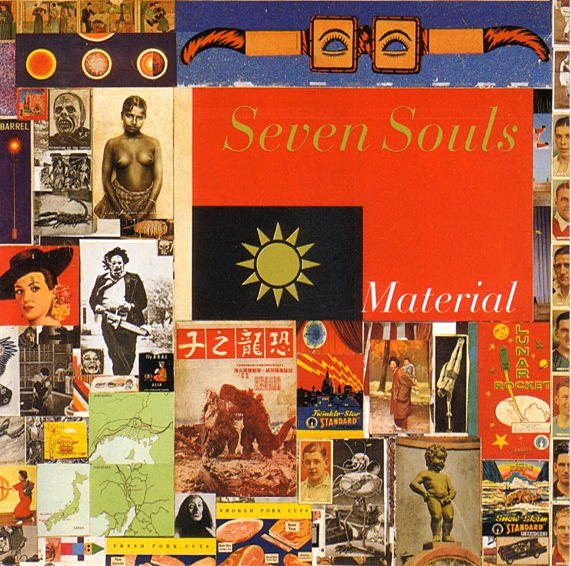
Seven Soul's Cover Art


A collage seems the perfect choice for the cover of this music for a few different reasons. The music itself is very collage-like especially when looking at the album as a whole. The musical elements and influences it weaves together include: Moroccan, West African, Illuminated Hip Hop, found sounds of Gospel preachers off the radio, funk grooves, and the spoken literature from one of the more rigorous modern explorers of consciousness.

Much of Burroughs' work collages words and images especially when it employs cut-up methods. Cut-up writings introduce randomity and chance operations into the literary process giving a great abstract effect. Collaged cut-ups and juxtapositions create new realities. David Bowie is another artist who has used the cut-up technique to inspire creativity. The tracks Ineffect and Equation contain music cut-ups.

Collages, especially this one, also effectively convey the feeling of travel through the Land of the Dead. The Land of the Dead, known by the Tibetans as the Bardo, is the primary theme of Seven Souls.

From reading the short bio I linked to, Ohtake seems the ideal artist to provide the visual component of this audio masterpiece. From the bio:

Shinro Ohtake takes the world as his source, using journeys, dreams and diaries to examine the inner surface of his layered perceptions.

The coincidence with the art was told to me last year at a Material concert at an incredible Austrian winery. This version of Material featured the songs of Gigi, Laswell's beautiful Ethiopean wife.

After the show, a dedicated Laswell fan, someone who will travel with his wife to see Bill play anywhere in Europe, whose name I neglected to collect, told me about a time when he visited Japan and happened to end up at a party at the house where Shinro Ohtake's original painting of the Seven Soul's collage lived. He walked into a room and there it was, quite the surprise. He recognized it immediately and starting telling the people around him the connection of the painting with Seven Souls. He also explained who Bill Laswell was. Unbeknownst to the raconteur, Bill also happened to be in Japan and, quite remarkably, turned up at the same party. Bill walked into the room that had Shinro's painting immediately after the fan finished talking about him. It was almost like Laswell had been invoked into physical appearance.

Saturday, July 10, 2010

Synchronicity, Burroughs, and Seven Souls

Continuing where I left off yesterday:

For a life-changing project like Material's Seven Souls, it only seems natural, yet still astonishing, that there would be significant meaningful coincidences, ie synchronicities, continuing in effect years later.

To start: I mentioned giving Burroughs Wilson's Coincidance : A Head Test shortly before he left with Grauerholz to visit Keith Haring. Haring was dying of AIDS, at the time, and didn't have long to live. Kind of an appropriate person to visit after you've recorded material on death and the technology of immortality.

One day, a few months later
, I arrived at the studio to find that entire lobby had been covered with Haring's signature graffiti art in black paint. The style resembled his famous "radiant baby" image


only less figurative and more abstract. The characters he had painted all over the walls reminded me of strange letters from an unknown alphabet. Haring hieroglyphs, if you will.

Six months or so after the Seven Souls session with William Burroughs, a new book of his arrived in Platinum Island's mail. It was called Interzone and consisted of Naked Lunch out takes. It had come to Platinum Island by mistake addressed to Haring's studio two floors above. By this time, Keith had shed his mortal coil. The studio manager picked up the book, saw that it was addressed to Haring and said to me, " He won't need this anymore. You're into Burroughs, you should have it," and then gave me the Interzone book. The upshot being that I had given WSB a book, Coincidance, and six months later a book from him came in return.

To be continued ...

Friday, July 9, 2010

William S. Burroughs in the Studio


The first session I ever worked on with Bill Laswell's Material involved recording legendary Beat writer, William S. Burroughs. 

 I had worked on a couple of previous projects with Laswell and his engineer, Robert Musso, at Platinum Island, the studio where I worked . They were mixes of albums by two experimental jazz artists, Yosuke Yamashita and Ronald Shannon Jackson. 

 At the time, I only had a vague notion of who William Burroughs was. Knowing of the session a few weeks ahead of time, I purchased a number of his books to become more familiar with his work. However, the 80-110 hour work week schedule as a staff engineer at a top New York studio prevented me from reading any of them except his first one, Junky, not exactly the best one for learning about Burroughs. The result being that I had absolutely no clue that I was about to see someone extraordinary.

I will never forget when we met. I was in the lounge when the studio manger escorted Burroughs in. As we shook hands, I had the very unusual experience of everything seeming to disappear except for the presence of Burroughs and myself. For a brief moment, it seemed like nothing existed except WSB and myself surrounded by white space. Definitely not what I was expecting. 

Burroughs was there to read from his most recent book, The Western Lands, which is basically his take on the Egyptian Book of the Dead material and the perilous adventures of life after death The music tracks he was going on were originally made by Laswell and Nicky Skopelitis for the follow-up to the generic Public Image Limited (PiL) album Bill had produced for John Lydon (Johnny Rotten) in 1985. Laswell and Lydon had a falling out over creative differences, the main difference being that one of them wanted to be creative. 

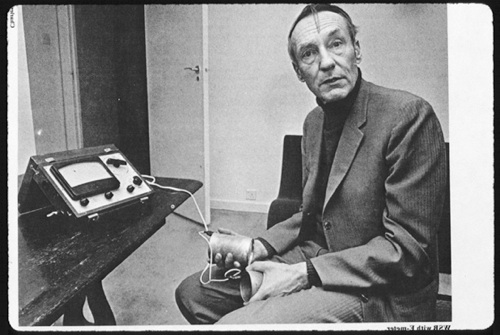
At Musso's suggestion, I had set-up a table with a lamp to get Burroughs feeling like he was doing a public reading where he usually sat at a desk. A vintage Neumann tube U47 microphone was suspended on a boom upside down with a wind screen, and tilted slightly in front of the writer. We recorded him onto a Studer 1/2" tape machine running at 30ips with no noise reduction. Burroughs was using a copy of the book that Bill had highlighted passages for him to read. After he read a few sections, it became obvious to me that Burroughs possessed a unique genius with extraordinary insight. 

For example: 

 The ancient Egyptians postulated Seven Souls. Top soul, and the first to leave at the moment of death, is Ren, the Secret Name. This corresponds to my Director. He directs the film of your life from conception to death. The Secret Name is the title of your film. When you die, that's where Ren came in. 

Second soul, and second one off the sinking ship, is Sekem: Energy, Power, Light. The Director gives the orders, Sekem presses the right buttons. 

Number three is Khu, the Guardian Angel. He, she, or it is third man out...depicted as flying away across a full moon, a bird with luminous wings and head of light. Sort of thing you might see on a screen in an Indian restaurant in Panama. The Khu is responsible for the subject and can be injured in his defense - but not permanently, since the first three souls are eternal. They go back to Heaven for another vessel. 

The four remaining souls must take their chances with the subject in the Land of the Dead... 

 Every now and then Burroughs would take a break and come in to the control room for a playback. His companion, James Grauerholz, would usually say something to the effect of, "great job, William, you're really doing well, etc..." Burroughs would either not respond to the compliment or grunt something inaudible under his breath. After the third or fourth time of Grauerholz giving praise, Burroughs became visibly perturbed and raised his voice saying, " IT'S NOT ME! IT'S NOT ME!!." 

What little I knew of WSB came from Robert Anton Wilson's book Cosmic Trigger. Wilson's current release at the time Coincidance : A Head Test, contained experimental writing that used computer software to employ the cut-up technique that Burroughs had popularized with friend and collaborator, Brion Gysin. I brought my copy and asked Burroughs if he'd seen it. He hadn't, so I told him about the software cut-ups and showed him the book. He became very interested, so I told him he could keep the book. Contradicting his dour reputation, he lit up in delight like a kid who has just received a wonderful present. He said that it was perfect because he didn't have anything to read on this trip or time to pick something up. Then he started talking fondly about having met Bob Wilson at some sort of panel discussion in the '50's. Burroughs and Grauerholz left shortly after to visit Keith Haring who had his art studio two floors above Platinum Island. The recordings Burroughs made that day appear on the Material album Seven Souls.

Six months later, standing in the studio's front reception area, the mail arrived. It included a newly released William Burroughs book called Interzone which was essentially comprised of Naked Lunch outtakes. It was addressed to Keith Haring but mistakenly given to us. Haring had died, succumbing to AIDS since Burroughs had visited. The studio manager looked at the book, saw it was addressed to Haring, and said to me, "he's not going to need it. You're into Burroughs, you should have it," and gave me the book. I had given Burroughs a new Robert Anton Wilson book and, "coincidentally," a new Burroughs came back to me from his publisher.

Wednesday, July 7, 2010

Jimmy Page's Mother and a UFO


Don't know if they're related, but I experienced both on the same night many years ago in the Canadian mountain resort town, Jasper, Alberta. Don't recall the exact date but do remember it being after Led Zeppelin's In Through the Out Door was out, and shortly before John Bonham died, which places it in the late summer of 1980. I was working for a band called Sargent, who was booked in the local rock club for a week.

Our employers put us up in a duplex townhouse about a mile and a half from the hotel where the club was located. They also booked entertainment into the hotel's lounge. The one-man-band lounge singer guy was staying in the other side of the duplex from us.

One night after the show he tells us this incredible story. Seems he was playing Stairway To Heaven - a very courageous thing to attempt in a lounge imo - when a middle-aged lady approached him after and said, "Thank-you very much for playing that song. My son James wrote it." He said that she was very polite and low key but seemed genuinely appreciative.

We told the lounge guy that if she happened to come back, to please invite her downstairs where we were playing thinking it pretty unlikely that we'd ever hear of her again. Much to our surprise, she returned to the lounge and the singer brought her to meet us.

I remember she said her name was Patricia. She said she was on a holiday trip from Wales where she lived. She was soft spoken with a light accent; very clear, direct, and down to earth. Not at all pretentious but almost beaming with pride at the accomplishments of her progeny.

On break between sets, she told us stories about her boy, James. She always referred to him as James. She mentioned his two teen-aged friends, Eric and Jeff, who also had a passion for playing guitar. That would be Clapton and Beck. Apparently Eric's and Jeff's parents weren't keen on their musical activities and wouldn't let them practice in their homes. Patricia was fine with it, so the three of them would gather in the Page house to practice their guitars.

Patricia said that now, ie 1980, Page was very secluded and wary of people's motives toward him and his wealth. Seems lot of obscure relatives and other hangers on came out of the woodwork after he got famous. She said that he considered Stairway To Heaven to be his finest achievement as a songwriter.

She stayed for one of our sets and then said goodbye. We asked her if she'd like some earplugs - it was a small establishment and the volume was strong. She declined and had no problem with the loudness. I guess if you've seen Led Zeppelin a few times you get used to it.

I felt incredibly high and elated walking by myself back to the rooms afterwards. Everyone else drove. It was a beautiful, slightly cool night in the mountains. The air was fresh and crisp. Suddenly I noticed 3 brightly colored lights streaking across the sky. They could have been planes flying in formation except that I couldn't see any kind of craft, and they appeared to be going extremely fast. I remember that they were different, intensely bright, pastel colored lights. My memory has them as pink, yellow, and green. Their trajectory arched across the sky. I thought they might be missiles and half expected an explosion when they disappeared over the mountain range. There wasn't, nor do I remember any sound associated with them as they flew across like you'd expect from a plane.

So I continued walking home, grateful that the world wasn't ending just yet. I was about halfway there still buzzing from the contact with Jimmy Page's mother.

Led Zeppelin had more influence on me growing up then any other band. They were the main musical component of my High School cultural education. I was 17 when their film The Song Remains the Same came out. It was playing at a theater about 3 miles down the road from the house I lived in. Once a week, for 7 weeks, I'd go see it, usually with friends, but sometimes alone, informally experimenting with what, I later realized, was Timothy Leary's/Bob Wilson's neuro-electric reprogramming recipes. Later, when I discovered that Page appeared adept with Aleister Crowley's system of Magick, I wondered if these ad hoc shamanic adventures might have opened doors enabling receptivity to Magick. The person who introduced me to Robert Anton Wilson, Aleister Crowley, and Magick, was Bob Gregory who ran the lights for Relay.

When I got back to the band house the requisite winding down, socializing was going on. Everyone was still pretty excited. In all the hub bub, I had temporarily forgotten about the 3 UFOs until an announcement came on the radio saying that many people had called in to report strange lights in the sky.

The next day the news reported that a Russian satellite had fallen out of the sky, that this accounted for the lights. This seems a weak explanation to me as it's unlikely that a satellite would randomly split into 3 pieces appearing in formation and reflecting a different band in the light spectrum. Also, there was the distinct impression of an intentional trajectory.

Well, I have no idea what connection, if any, these two events have except they took place on the same night. Some researchers, like Kenneth Grant, connect UFO phenomena with the occult. I don't know. The jury is out on that one.

Friday, July 2, 2010

Rammellzee


I just heard that Rammellzee, a truly original artist, died this past Sunday. He was one of the original grafitti artists, a friend of Jean-Michel Basquiat, and was called a pioneer of hip-hop music.

Randy Kennedy wrote a good piece on him in The New York Times.

Some highlights from the article:

He cast himself as an urban philosopher whose overarching theory, which he called Gothic Futurism, posited that graffiti writers were trying to liberate the mystical power of letters from the strictures of modern alphabetical standardization and that they had inherited this mission from medieval monks...

In 1984 he had a small part in the Jim Jarmusch movie “Stranger Than Paradise” as a kind of deus ex machina, bearing a cash-stuffed envelope toward the end of the film. In an interview in The Washington Post the year the movie came out, Mr. Jarmusch said he considered Rammellzee a mad, overlooked genius.

“He’s the kind of guy you could talk to for 20 minutes and your whole life could change,” he said. “If you could understand him...

"Ms. Zagari Rammellzee said his illness had slowed him down over the last few years and prevented him from pursuing a prodigious list of ideas. But she added that he never viewed death as an end, only a change in forms."


The Times didn't mention that Rammellzee was also a member of Bill Laswell's loose collective of musicians known as Material. His track on Material's Seven Souls album is called Equation.

He reminded me of someone out of time, like a visitor from the future who got caught in the backwaters of time but turned it into a creative advantage.

Perhaps he's best remembered in his own words. From Equation:

This is a letter you can give only a malfunction to the mind,
basically leads straight from the heart to the brain,

wants you to go insane,
as you read the intertwining messages,

open up to page one .... one ...
one... one...

This is a military function information equation coming down straight from A
to Z.

We have nothing else but to say and leave a retreatable rhyme
that can only be so far back in time that your mind will turn to will washes and bubblegum factories.
Dash replied to yesterday's posting, and offered some interesting suggestions:

"So far Hazrat Inayat Khan's The Mysticism of Sound and Music has been extremely influential as well as my studies into the Native American Way and Shamanism among others. Like you said, my experiences in the Sweat Lodge Ceremonies and Native American Peyote Ceremonies have offered far more than any books could have.

Cymatics has always been extremely interesting to me because it seems to prove that matter is animated and structured by vibration - the implications for music and its effects on humanity are profound."


Thanks, Dash! Nicky Skopleitis gave me Khan's book awhile back but I didn't really connect with it at that time. I'll have to give it another go. This is the first I've heard of Cymatics. It sounds closely related to Gurdjieff's ideas as outlined by Ouspensky in In Search of the Miraculous.

Two excellent works of fiction on this subject are:

The Bear Comes Home - Rafi Zabor. A heady mixture of jazz music and culture, and Sufism from an adept of both. Zabor worked with Reshad Feild's school at one point.

Finnegans Wake - James Joyce. A difficult, mind expanding study that can take years to appreciate, but is well worth the effort. Joyce was a good singer and wrote as musically as he could. The secret to hearing its music is to silently sound out all the coined words and phrases. It's easier to approach and understand the Wake as an incredibly complex piece of music than it is to follow a storyline. Joyce was a visionary qabalist and had a profound understanding of magick as evidenced in Finnegans Wake.