Friday, August 23, 2013

Crowley Demystified

Just kidding, it doesn't seem possible from a guy who said, "Magick is getting into communication with individuals who exist on a higher plane than ours.  Mysticism is the raising of oneself to their level."

However, the title works, it's a real attention grabber so in the spirit of it, I will present Aleister Crowley's researches as simply and lucidly as possible according to my own understanding.  I've been asked a few times over the years: "where to start with Crowley?"   I found it a difficult question because of the multi-faceted nature of his output - different people will initially respond better to different areas - so I usually suggest reading Robert Anton Wilson's overview of Crowley in Cosmic Trigger I.  That was my introduction to the mage.

Some preliminary remarks:

What follows represents my own study and researches. 

Crowley communicates on many levels.  That's why his books so richly reward rereading.  While the lenses of perception get cleansed and magnified through daily practices, understanding and comprehension grows and develops through experience.  More on his multiple layers of communication later.

The first time I read Magick in Theory and Practice sometime in the early '80's, I turned it into a Magical Retirement, that is to say, I dropped out of all the conventional social games and spent a week concentrating on reading and digesting the book and doing some spiritual practices.  I rented a room above a dive bar, The St. Regis Hotel in downtown Calgary, Alberta and fasted from food, drugs and alcohol.  After morning yoga, I'd walk around downtown Calgary and find somewhere interesting outdoors to read the book.

I understood very little of Magick in Theory and Practice then, but enjoyed it immensely.  It would often read like mysterious, abstract prose/poetry; a definite mood descended hard to convey.   Some of Rimbaud's poetry comes close. Even though most of what I read didn't make a lot of sense at the time, I did have a distinct feeling that information was reaching a deeper level. 

Yet one section jumped out as lucidly clear and easy to comprehend.  The Introduction to Magick in Theory and Practice (Part 3 of Book 4) where Crowley gives the definition of magick and follows it up with a series of theorems, illustrations and examples in scientific-like fashion.  Before the definition he writes:

I swore to rehabilitate MAGICK  to identify it with my own career ... 

Crowley defines magic as the Science and Art of causing Change to occur in accordance with Will.

The theorems go on to explain his basic philosophy.  For instance:

23.  Magick is the Science of understanding oneself and one's conditions.  It is the art of apllying that understanding in action..

24. Every WoMan has an indefeasible right to be what (s)he is.

Just reading that relatively short Introduction will provide an excellent expose of Crowley's motives and intentions.

After the experiment ended, I felt energized, enthused and inspired though I didn't quite know exactly why since I seemed only marginally further along with grasping how magick works and practicing it.  I did have a good time with it at least.

Crowley appears more interested in having the reader think for themselves rather than blindly following his instruction.  Sometimes he'll deliberately mislead to keep the reader on their toes.  You'll also find a great deal of humor in his writings even in the most serious subjects.  Everything might not need to be taken as literally true, or maybe it is, everyone has to decide for themselves.  You'll find paradoxes, riddles, hidden jokes, contradictions, blinds, dead ends, outrageous allegory, illuminated inuendo etc. etc. etc.  Taken all together, Big Al's writings can seem like a vast labyrinth,  successful navigating of which constitutes part of the student's training.

Crowley applied the principles and practices of Science extensively toward his endeavors at consciousness transformation through magick and mysticism.  He studied Chemistry in college and stayed fairly current with developments in Science throughout his life.  He invokes Einstein's Theory of Relativity on the first page of the Book of Thoth, a book which summed up his occult knowledge and cosmological viewpoints through the tarot.  It was written near the end of his life.

Robert Anton Wilson suggested that Einstein introduced Relativity in Science, James Joyce introduced it in literature while Crowley introduced Relativity into spirituality as he sought a stronger scientific grounding in the mystical arts. 

We place no reliance on virgin or pigeon
Our method is science, our aim religion.

Is a motto Al came up with for the O.T.O.

A core textbook of Crowley's system is MAGICK, Liber ABA, Book Four.  It's divided into four parts which are:  Mysticism, Magick ( Elementary Theory), Magick in Theory and Practice, and Thelema: The Law.  The most current edition, put out by Weiser's, is affectionately known as the blue brick for it's blue dust jacket and size.

Part 1 Mysticism has on the title page below the title:

 MEDITATION

THE WAY OF ATTAINMENT OF GENIUS OR GODHEAD CONSIDERED AS A DEVELOPMENT OF THE HUMAN BRAIN

The scientific attitude shows right at the very start.
 
In the book Cosmography Buckminster Fuller gives his favorite definition of science which could equally apply to the practice of magick:
 
"Sir James Jeans pronounced what is to me the most sensitively inclusive and accurate definition of science when he said, 'Science is the sincere and consistent attempt to set in order the facts of experience.'"

Where magick and other esoteric practices such as Jungian active imagination differ from conventional science is that they acknowledge the validity of (so-called) inner experience to cause change (ie magick) in an intentional way to oneself and one's environment ( ie one'sSELF).  Magick also allows for the experience of receiving non-ordinary communication.
 
* * * * * *
Before we go too much further it seems prudent to separate the myths and superstitions of the man, Aleister Crowley from the work and system of radical brain change transformation and development he presented.
 
Crowley carries one of those charged names that conjures lots of superstitious nonsense in the minds of the public who have only heard of his sinister reputation.  The reason for this largely undeserved reputation, and the abundance of false stories surrounding him, some of them self-perpetuated, remains a subject for another time.
 
The man, however, definitely behaved unsaintly at times.  It appears just as much of a mistake to worship him as an infallible holy guru as it is to revile him as a black magician and doer of evil.  Both make the mistake of confusing some Crowley personality legend with his work.  Confusing the message with the messenger.
 
The multiple levels of communication he wrote in seems cognate with the multiple levels of consciousness he experienced and mapped out.  Yet, in the Book of Lies he reveals that not even he can always tell the difference when he writes in ch. 56:
 
"So wrote not FRATER PERDURABO, but the Imp Crowley in his name
For forgery let him suffer Penal Servitude for Seven Years; or at least let him do Pranayama all the way home....
And yet who knoweth which is Crowley, and which is FRATER PERDURABO?"

Frater Perdurabo (brother who will endure onto the end) was one of Aleister's magical mottos.

Western culture worships personality.  We expect our heroes, especially our religious figures to be god-like.  Their behavior should be in accord with the ideas they espouse.  While this certainly makes sense to some degree, prophets and philosophers gain more credibility when they live up to the ideas they preach, it ignores the common experience of envisioning a way of life far beyond one's current capacity.

Nietzsche and his Superman, Ouspensky and his New Model of the Universe, both Crowley and Gurdjieff with their ambitions for a network of "schools" criss-crossing the globe give some examples of idealistic visions difficult to attain, at least within the immediate timeframe.

Crowley once wrote something to the effect that he was the worst Thelemite because he was the first.  Elsewhere, in a letter to a student, he wrote that he meticulously recorded all his experiments in a diary so that those who followed him could learn from his mistakes and failures.

None of this is meant to excuse Crowley, he doesn't need an excuse or apology, the work he did on behalf of all is quite extraordinary.  It's meant to show that the imp Crowley need not unduly influence the experiments his work suggests.  Indeed, it's quite possible to get the gist of Crowley's vision without ever hearing about him or his jargon.  I'll provide some examples a little later.

Incidentally, several years ago I had a similar conversation with Bill Laswell, separating Crowley's system from his reputation, sitting in the lounge at Masterdisk mastering studio in New York waiting to master the Ramones album, Brain Drain we had just finished mixing ( mix engineers Robert Musso and Jason Corsaro hadn't arrived yet).  As we were talking, I happened to notice Joey Ramone from the other end of the lounge paying attention to our conversation.  He was the only Ramone present.  I have no idea what, if anything, he thought about the subject.
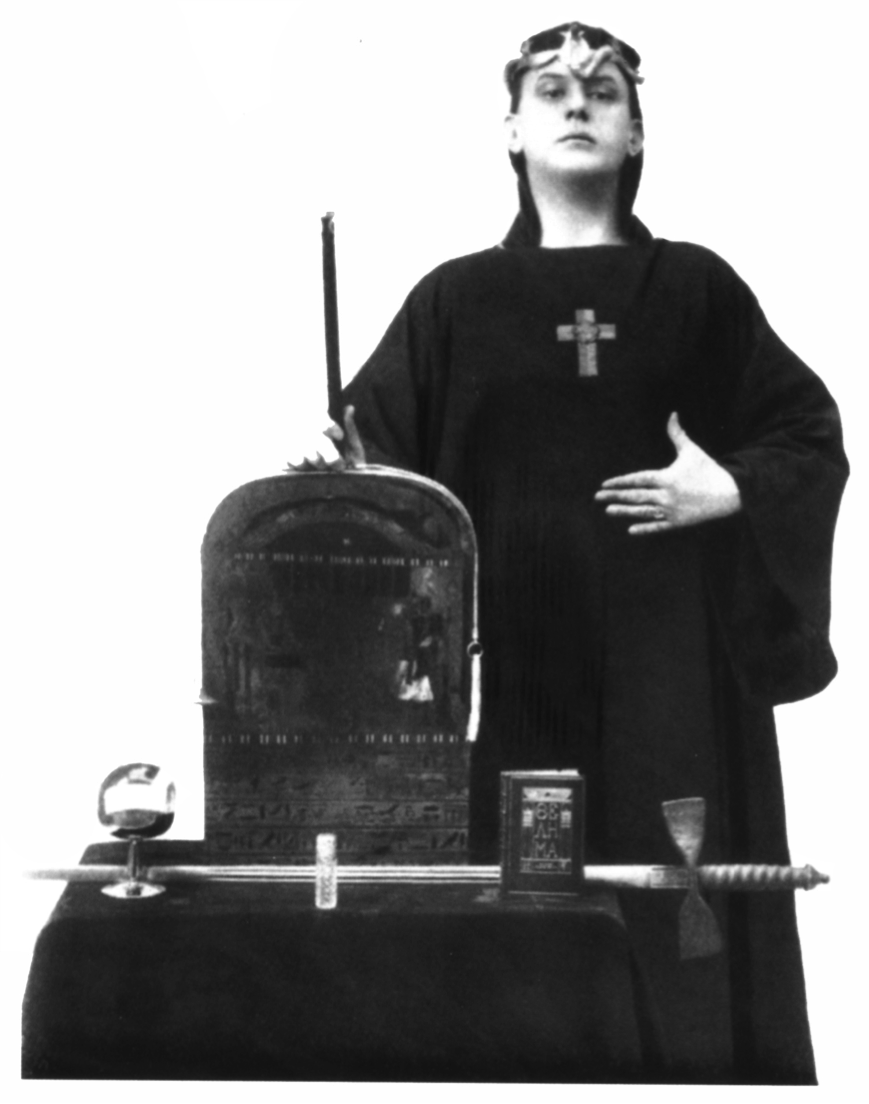
Aleister Crowley ready to rock!

* * * * * *
A root principle of Crowley's system is Will.  That internal dynamic force able to deliberately plot a course of action and carry it out.  Crowley called his system Thelema, the ancient Greek word for Will.  He believed that every individual has an intrinsic purpose for incarnating on this planet and that their life may function optimally by discovering this purpose and carrying it out.  He called this purpose True Will and declared that Higher Intelligence had given him an instruction to pass on to humanity: Do what thou wilt shall be the whole of the Law.
 
So it seems that an initial step on the path of Thelema involves formulating or discovering one's True Will.  This seems hardly a new idea, bearing close resemblance to the age-old instruction gnothi seauton - know thyself found in the ancient Egyptian temple of Luxor, the Oracle of Delphi, and used extensively by Plato in his dialogues. 

Samuel Coleridge had a poetic view of this self-examination:

"She looked at her own Soul with a Telescope.
What seemed all irregular,
she saw and shewed to be beautiful Constellations;
and she added to the Consciousness hidden worlds within worlds."

                                   
 Some people have difficulty formulating a True Will but it's really not that hard to begin this process.  It might help to remember that the elaboration of True Will functions more like a continuous journey than an end point.  It's not necessary to come up with the ultimate purpose of your existence in order to begin formulating a True Will.  One way to start - just look at what you like to do.  What are your proclivities?  How would you spend your life if you could do whatever you wanted if time and money were no object?
 
E.J. Gold writes somewhere that the first question a student gets asked when applying to an esoteric school is: "Why are you here?"  It can help reveal, unveil, prod or provoke True Will by asking, why am I here on this planet ... in this body... at this time. ... with this set of life circumstances?
 
The answer to the question 'why am I here,' and thus True Will tends to get modified and refined with time and experience.  For example, take someone who works in a shoe store and enjoys it.  They could start by saying, 'I am here on this planet at this time to sell shoes.'  Later they might consider and reflect upon the various ramifications of selling shoes.  Comfortable shoes help people function better in their jobs so maybe the salesperson's True Will has something to do with providing a service that helps people do their own thing?
 
I use this somewhat absurd example for two reasons.  The first is because I asked Robert Anton Wilson at a workshop what the purpose of Evolution was?  He replied that he didn't know but he hoped it had something to do with making more comfortable shoes to lecture in.
 
The second reason is to demonstrate that True Will doesn't have to manifest as some high falutin' idealism like saving the planet or making the world safe for consumerism.  It seems just as effective for apparently mundane activities.  It could be a person's True Will to be a good accountant or bookkeeper, a construction worker or a school janitor.  John Lennon's primary purpose in life from 1975  until 1980 was to raise a child, it seems.

Earlier, it was Lennon's will, along with thousands or millions of others, to end the Vietnam war.  I mention this because Lennon had a particularly creative and demonstrative approach to applying his will to end the war.  That war did end as a result of anti-war pressure.  This brings up a theme that we will return to and investigate later, that magick can change and/or influence events on a large scale.

It seems that when Presence, Will, and Attention focus in the same direction the momentum of entire Scenario Universe is on your side.  However, it's not always easy to stay aligned to True Will.  Endless distractions, social pressures and other obstacles appear such as the need to 'make a living' that can temporarily impede what you really wish to do.  Crowley maintained that he only got into trouble when losing sight of his True Will.

Buckminster Fuller experienced the same thing when he dropped out of society to pursue his own vision.  In Cosmography he writes:

"It seemed to me that I was clearly informed on how to proceed.  If and when I was doing first what first needed to be done, working out the most effective strategies in pure principle, I would be able to carry on successfully.  If I was not doing things in proper order or doing irrelevant things, I would be unable to carry on.  If I was not getting along, I would change course and look for a way to return to smooth sailing."

I use Fuller as an example to begin to demonstrate that the paradigm Crowley articulated appears common to many different disciplines and belief systems.  To my knowledge, Fuller did not incorporate Crowley's writings into his world view.  No evidence appears that he ever heard of him.  Yet, there exist striking similarities between Fuller's approach and Crowley's system.  Fuller could even be accurately called a model Thelemite, ie. an empowered individual, in my opinion.

For instance, here is how Bucky describes this new paradigm:

"I posited, for example, that humanity was entering an unprecedented state of comprehension of principles and mental competence adequate to the epochal inception of conscious, spontaneous, voluntary realization of magnificently essential, new-to-Earthian humans, functioning in Universe.  This new stage of human evolution was no longer automatic, but a matter of conscious will."

- Cosmology, p.14-15

TO BE CONTINUED...

Wednesday, August 7, 2013

Yothu Yindi part 2

I left this story talking about the effect the indigenous art had on me in the studio:

  It got a bit unnerving at times as I would feel surrounded by nonhuman, interdimensional life forms that seemed much bigger and more vast in scope than anything I was familiar with.  Like stepping in or having a direct view of what Carlos Castaneda calls the Nagual - an observable realm outside known reality.

One day I discovered photos of some artwork on top of the rack beside the mixing desk.  Looking at them, I immediately noticed their strong resemblance to a series of paintings by E. J. Gold called City in the Sky.  It turned out to be more indigenous art submitted by a woman to lead singer Mandawuy Yunupingu for consideration.  The congruency between this woman's art and Gold's City in the Sky paintings appeared so close that it made me wonder if visionary realms were consensual and observable by others?

This painting by E.J. Gold has a similar feel to the City in the Sky series.
 
As mentioned previously, a lot of resistance met this project.  For Bill and I this reached its height  when we were threatened with jail if we didn't explain what we were doing in Australia. Apparently another producer, someone who worked with all or most of Australia's pop groups at the time, had phoned the Immigration Authorities and filed a complaint. It was true, Mushroom Records hadn't given us proper work visas. I felt nervous, but  Bill  calmly told these Feds we were only rehearsing at the studio in preparation for recording them for real back in New York. They accepted our story with very few questions and appeared even more relieved than us with this legally approved reality scenario presentation.
 
Not long after, we met the producer who had ratted us out.  I was surprised by Bill's equanimity towards him.  He could care less that this guy had tried to get us busted.

We recorded 6 songs with Yothu Yindi.  The music was created organically from the ground up.  Percussion tracks were recorded one at a time against a click.  Some songs had a full drum kit recorded on top of that.  Bill played bass on a couple of tracks giving them a very strong rhythmic and melodic foundation.  He also created the arrangements and song structures.

A pair of the usual suspects from Bill's New York circle of musicians, Nicky Skopelitis and Bernie Worrell, were also on hand for the proceedings.  Nicky tastefully layered 6 and 12 string guitars while Bernie added a Hammond B3 organ, piano, and his trademark clavinet through a wah wah pedal talking alien.

Lyrically, the songs presented strong expressions of the Yolgnu culture with their trials and tribulations amongst the Anglo world. 

Gone is the Land remembers the innocence of growing up in the bush with a strong connection to the earth, and how that changed when the colonials set up shop

Gone is the land
to a man of the mind.
Can't you see what you've done
to me

Despite this dark theme of a way of life getting oppressed, the bridge comes in and blasts the mood into a positive, "we can do anything" dimension via a synergetic weaving of sonics, melody, energy and words:

Happiness is a real thing, it's a real thing

but then warns,

High tide is coming in,
The pigeons call, the sharks are here.

Mabo was given an uptempo reggae treatment.  I don't fully understand the story here; many of the lyrics told in the traditional language.  Mabo seems an ancient Yolgnu legendary figure. A hero.  His spirit tells a story and he has a law:

Mabo's law is standing firm
Shedding power for us to be strong
Spirit, law, culture and all
Showing the world
See our law


The clash of cultures then gets called out again as they go into a chant:

We were right
That we were here
They were wrong
That we weren't here...


This references some of the racist propaganda claiming that the native Australians weren't there when the Europeans first arrived.  I don't know how this wacky theory attempts to explain their presence.

Though this might look like standard socially relevant protest music, it should be remembered (from the previous post) that lead singer Mandawuy Yunupingu was bearing the brunt and right in the heat of this kind of nonsense from having been named Man of the Year.  Right wing talk radio jocks were busy inciting public hatred and organizing demonstrations against him.  In that context, these lyrics become extremely confrontational.

One piece was a completely traditional Yolgnu song with instrumentation consisting only of didgeridoo, clapstick and vocals.  Many but not all of the lyrics were in English.  It seems to be about two mysterious female travelers bringing great wisdom to the land.

Another instrumental piece became a hybrid fusion of traditional instrumentation seamlessly blending with the trademark Laswell ambient dub composing style.  The recording studio as one musical instrument in the production. 

One of the most intense sessions for me, of this or of any other project, was the didjeridoo overdubs.  The Yolgnu play a specific type of didjeridoo called a yidaki particular to their tribe. 

I got to this session a little early. A large, muscular Yolgnu was setting up the space where he was going to play.  Two others were standing very still to his right.  I felt an instant silent rapport with the two standing still.  There seemed no need to introduce myself, make conversation, or go into any of the other social routines that distract from pure being contact.  I felt totally comfortable with these complete strangers.  Then I saw a smallish ball of shining, radiant light about the size of a grapefruit just behind and to the right of each of the two Yolgnus standing still.  It's the one and only time I've ever seen anything like that and it didn't last that long.

The yidaki player, Bunimbur Marika still rates as the best dijeridoo player I've ever heard.  The strength and focus of his breath resonated powerfully into the rich, rolling timbre of the instrument.  The deep low frequencies pushed the air just as massively as Sly Dunbar, Jah Wobble or Bill Laswell do when playing dub/reggae style bass though a large P.A. 

At one point we ran his yidaki through a subharmonic synthesizer.  The effect produced ridiculously huge low end.  We ended up not using it though,  After our run-in with the Immigration Authorities, we became a little concerned with causing neighborhood seismic worries or of distracting the flight patterns of  jets flying by overhead.

Marika wore a black leather Harley Davidson motorcycle jacket the whole time he recorded.  Someone told me he was the king.  I took it to mean king of yidaki players not king of the Yolgnu.

The final resistance to our participation with Yothu Yindi came from the label's fear based perception that the songs didn't sound commercial enough for the marketplace.  We finished by doing some good rough mixes, mixes that I still listen to this day because I like the songs and it brings back memories.  The label gave the tracks we had done to another producer who added generic synth pads and drum machine samples.  It gave the tracks a harder, brighter, more machine-like sound.  Robbed them of their soul, in my biased opinion.  Biased because I know and experienced the power of the soul those songs at one point possessed.

Diluting our contribution didn't bother me in the least. I wasn't concerned about or lusting for any particular result.  The experience proved quite extraordinarily life-changing.  I was very grateful just to be there.  I felt energized, charged and to be perceiving things in new ways.  Naturally very high seems another way to put it.  The fallout of close contact with an ancient culture for a set period of time.

Walking to the back of the line to board the plane at the airport I happened to notice an exceptionally beautiful young lady standing in line; an unreal, contemporary, fairy tale beauty like Snow White meets Princess Lea.  As fate would have it, we were seated in the same aisle of the jet with an empty seat in between.

I don't usually strike up conversations with strangers but she started spontaneously opening up to me early in the flight.  She said her name was Emma and that she taught physical fitness in Greece where she lived part of the time when not in England.   I don't remember what she was doing in Australia but she was on her way to Iceland.  Her father owned an island in Zanzibar, and she had spent time in Africa growing up.

Emma complained and lamented to me that most people only related to her physical appearance, thus her relationships felt superficial.  A classic poor little rich girl story.  It seemed obvious to me that she was looking for being contact.  I don't recall how this connected with her concerns but do remember responding by talking about John Lilly, floating ( in a floatation tank), dolphins, and the Law of Three.  

Ironically (to me), the movie they screened was The Bodyguard with Kevin Costner and Whitney Houston.  It's about a former Secret Service agent hired to guard a pop star.  Surprisingly, I enjoyed it.  Whitney Houston's acting was much better than expected and even Kevin Costner was bearable.  Emma didn't like the film, she thought it was very cliché.  Whitney Houston got her professional start in the entertainment industry recording with Bill Laswell at age 16.

After we went through customs in LA, I never heard from or saw Emma again.  Some people you just work with for a brief but intense period of time before moving on.

About a week later I was getting on a flight to Europe with John Zorn and Bill to mix a Painkiller show.  I noticed that TIME magazine had an actress on its cover whose first name, Emma, was printed in large stylish letters.  I tried telling Zorn about this coincidence but only succeeded in confusing him. 

Qabalistically, I connected the name Emma with the  Hebrew letter mem which corresponds with The Hanged Man of the tarot.  In some systems, The Hanged Man represents the first stage beyond ordinary personality, the first stage into the Deep Self.  Mem is also the letter that corresponds with the element Water.  The whole experience with Emma occurred in flight over the Pacific ocean.

This strange upscaling of perceiving and functioning that I took home from the Yothu Yindi encounter lasted a good 3 or 4 months.  I'm not sure that it ever went away or if I just got used to it.


Saturday, July 13, 2013

A Taste of Africa

Dropped in to see my friends from Kanaga System Krush busy editing a long awaited documentary on the music of Mali, West Africa.  Called Life is Hard, Music is Good, it seems likely to set a new standard for documenting African music and the lifestyle that goes with it.

Editing might be the hardest part of this venture six years in the making.  Blessed or cursed, depending on your view, with a wealth of riches in terms of footage captured, a few hundred hours at least, the challenge now is to get it down to a two hour running time.

The editor is Margaret Byrne whose credits include Mary J. Blige and Black Eyed Peas.  Director of Photography David Nicholson had another editing station set up and was busy with P.J., one of the Producers, sorting through and compiling archive footage for inclusion.

Somebody asked me, "what's happening?"
"This is IT! This is what's happening," I replied.

I felt in the middle of a media laboratory involved in experiments with very high energy particles & waves imaging sound & vision.  Collecting, organizing, assembling and reframing discrete moments of time and experience. Cohering to a vision that tells the story of music that keeps a culture together (most of the time), spiritually thriving, vitally and magically alive.  This music, the music of Mali, like all genuine music, transcends hardship to a greater or lesser degree.  Life is hard, music is good.  Editing is hard.  Communicating a musically rich culture is good.

The editing suite spilled out into an outdoor terrace shaded by a couple of oak trees.  A long wood  bulletin board ran the length of one side displaying cards depicting the various people and elements making up the film.  They were vertically divided into categories under the headings of different themes.  Not quite a storyboard but still quite a comprehensive layout of the form of the film.

KSK head honcho Aja Salvatore could be found fashioning a djembe on the terrace when not making executive production or directing decisions.  Aja was aided and abetted by a djembe player from Mali, Seydou who had recently acquired his visa to live here after trying for years.

In Africa, Seydou was almost always on hand to help us out on our musical expeditions.  He
always showed me great respect and friendship once giving me a traditional shirt as I was leaving.  The last time I saw him, about 2 1/2 years ago, I gave him a very basic Brane Power beta blocker, a small quantum crystal radio designed by E.J. Gold.  It's a biofeedback device meant to help cancel the brain's beta waves, ie headbrain chatter that' gets in the way of more relaxed states.  I showed him how he could use it to increase his will power.  I guess it worked!

The temperature was Africa hot.  A little more humid than usual compared to the sub-Saharan climate of Bamako, Mali, and it felt nowhere near as dusty as it gets there but still the kind of hot you take notice of and have to deal with.  But if you've worked in Africa for any length of time then you know how to deal with the heat.

Aja finished shaving the hair off the goat skin drum head he had stretched over the djembe shell then he and Seydou tuned it up.  The only thing left to do now was play it.  Aja started playing one of the more traditional African rhythms he picked up in Segou, capital of the Bamana Empire in thje 16th Century.  Seydou started playing what I thought was a small dun dun (African bass drum) with a stick mallet.  In his left hand he held a metal bell with a metal striker on one finger like a ring.  They worked up a deep African groove that sang through the sedate residential streets sounding like a call to go on a mystical journey.  Some people passing with big smiles excitedly said they could hear the drumming all the way from the top of the hill. 

In Bamako it's common to hear drumming going on somewhere in the distance.  I once asked someone there why so much drumming and he said that they often do it for some particular intention.  To drive away bad spirits from someone or find something that's lost, to change the weather or give blessings at a wedding etc. etc.  Nevada City had a little taste of Africa in their midst.

Aja and Seydou ostensibly intended to test the sound and playability of a newborn djembe - which sounded great, by the way, clear, articulate, tonal and confident.  But I suspect the African ambience they created indirectly fed the editing process by creating a specific mood of the homeland outside of the pixellated and digital electronic quantum world where the documentary was taking shape.

I'm looking forward to mixing the audio.

Here's a preview:


Wednesday, July 10, 2013

Yothu Yindi

Mandawuy Yunupingu, leader and main songwriter for the Australian band Yothu Yindi died about a month ago at the very young age of 56. He was a powerful musical presence, and a highly respected cultural leader amongst indigenous Australians.  One obituary called him "a giant among his people."  It goes on to say:

"Biographer Robert Hillman says Mr Yunupingu had a great sense of mission about his people.

"It was part of his vision that music could become a political agent in making broad mainstream Australia more aware of the rich Indigenous culture of his people."

Mandawuy Yunupingu
 
Bill Laswell and I had the great honor to work with him and Yothu Yindi at the beginning of 1993 in Sydney, Australia.  The pressure around Mandawuy was intense at the time.  He had just been named Australian of the Year for 1992.  This had triggered a wave of racist invective directed against him.  A popular, Rush Limbaugh-like radio mouthpiece led the charge saying that the only reason he had received this accolade was because he was black.  Protesters demonstrated against him.  I remember seeing some footage of them on the news.  All this was going on as Yothu Yindi started recording a new album.

Mandawuy seemed noticeably affected by this racist nonsense yet it didn't slow down his drive to document their new music.  He had a core strength of being that didn't waver from his purpose.  He also knew magic.

Early in the project Yunupingu placed a circular, orange and white ritualistic headband on the top center of the mixing console and said, "this will give it some magic.  Later, I asked him the significance of this talisman.  He said it was "Baywara," and emphatically stated, " This is my Mother.  She is the most powerful one ever.  I am the child and she is the Mother."

In the Yolngu language Yothu = child, Yindi = mother.

Mandawuy also called Bill "Baywara" and said that he was the "Man from Nothing."

One of the songs we recorded was called Baywara with lyrics such as:

Maker of the land
Maker of the song
Maker of the constitution...

Lightning she spoke
The
power of one
Into the sea
Where the splinters fell
Her mind at its best
She did create
Baywara Baywara


My initial experience with indigenous Australians took place on a trip there a few months earlier.  Bill brought me down there to help with some remixes for the band Icehouse.  They also recut a new version of their hit song Love in Motion as a duet with Icehouse lead singer Iva Davies and Christina Amphlett of the Divinyls.  We worked at the EMI studio in Sydney.

At that time, normally Autumn of 1992, but down there it was Spring, Yothu Yindi was at the top of the pop charts.  They were the first to incorporate and blend traditional indigenous music with Anglo pop music forms.  It went over very big.  That inspired Iva Davies to use that sound on the remix of their signature song  Great Southern Land.

Unfortunately, Davies didn't know any native Australians who played traditional music.  Someone had the idea to go to one of their settlements, areas that were exclusive to the Indigenous.  These reminded me of Native American reservations.  These settlements required a government permit to visit that normally took months to obtain, however, Davies was able to circumvent the red tape.  He acquired our permission to visit in a few days.

I assembled a portable recording rig to take into the Outback basically consisting of  the same gear I brought to Morocco to record the Master Musicians of Jajouka except we didn't bring a generator.

Laswell, Davies, and I  took a commercial flight up to Darwin, the most northerly city in Australia with a short stop to refuel in the centrally located Alice Springs .  We spent the night in Darwin.  The next morning we loaded our gear onto a small, 4 seat  propeller plane and flew to the Galiwin'ku native settlement on Elko Island.  We were told that the only way in or out was by plane.

An official looking 4 wheel drive Land Rover station wagon picked us up at the landing strip and drove us to an empty house in the community where we would spend the night.  The settlement seemed very surreal, like something out of a Jodorosky film.  The most anomalous aspect was its resemblance to an inner city slum yet surrounded by beautiful countryside and wilderness.  It also reminded me of the Old West.

The heat was intense.  So hot it seemed to make time slow down and crawl by.  There was one all purpose general store, relatively large, about the size of a supermarket.  It didn't have regular hours but there was a rumor that it would open at 1pm.  At 1, people started gathering outside and waited until it finally did open at about 2:30.  Though the store was large, many of the shelves were bare or only had a few items. 

We walked around the community looking for some musicians to connect with but without success. That night a group of musicians showed up at our house and said they had some songs for us to hear.  I quickly set up some mics and the recording equipment.  They played about 5 or 6 original pieces.  The multi-track recordings turned out fine, but Bill didn't find any of the music suitable for what we were doing except for solo didjeridoo playing which we used extensively.  I ended up putting one of their songs, Marralyil, in a collection of ambient recordings, All Around the World.  We didn't get their names so I was only able to credit the place, Elko Island.

The house we stayed in was completely empty except for a kitchen table, a few chairs for it, and a fridge.  Bill and I slept on floor that night.  Iva Davies slept on the table. 

We left early the next day.  It was a long way to go to get some didjeridoo samples but quite worth the adventure, in my opinion.  Flying back in the prop plane we spied some kangaroos  running about their natural habitat.

A few months later, back in New York,  Bill got a call from Yothu Yindi's Australian label, Mushroom Records, asking for his help with producing their next album. 

It often seems that when something positive tries to manifest itself that it gets met with a great deal of resistance or opposition.  I ascribe this to Gurdjieff's Law of Three, the idea that all phenomena contains a mixture of three forces; affirming, denying and reconciling.  This compares with Ohm's Law in electronics which states that every electrical circuit has current, resistance, and voltage ( the electrical potential of  current multiplied by resistance.) 

This Yothu Yindi project became a classic case of something very positive trying to come into existence against all kinds of resistance.  Eventually the resistance won, but not on our watch.  I'll explain later.

To start with, uncertain financial concerns with the label nearly scuttled the mission before it began.  It still wasn't resolved the day of my flight to Australia.  Two hours before I needed to leave for the airport the call from Bill's office came through that the trip was on.  I was confident that it was going to happen and Bill must have been too as he had gone down a few days earlier to work with Mandawuy in his home in the Outback. 

The flight from New York to Sydney, Australia incurs the worst jet lag I've ever experienced.  Also, my bio-chemistry had been sensitized by shamanic experiments I'd been doing with the floatation tank that week.  This made my first day there physically and metaphysically quite uncomfortable and disorientating.  I felt like I'd been beamed down to another planet like in Star Trek only my body didn't fully materialize.  My consciousness seemed partly there and partly scattered through vast regions of space.  Fortunately, I had a couple of days to recover before Bill arrived from the Outback.

We were booked to work at EMI's Studio 301 again, the longest running recording studio in the southern hemisphere, established in 1926.  We also stayed at the same hotel as before, The Southern Cross - coincidentally the name of a favorite chapter from Crowley's Book of Lies.  I had recently purchased  The Equinox, Crowley's ten volume periodical publication that held all varieties of occult wisdom.  I brought Volume I with me and spent my time waiting for Bill reading John St. John, a record of Crowley's "Great Magical Retirement" in Paris.  One point of that essay showed that a person could do intense magical work while still living a normal and social outward life.

Consequently, I decided to visualize and invoke the godform Mercury as much as possible during this period of recording Yothu Yindi.  The primary prayer I used was the Invocation of Mercury from Crowley's Rites of Eleusis.  Mercury functions as the god of communication among other things.

A rationale for working in this way is shown by Lon Milo Duquette in his book, Angels, Demons & Gods of the New Millenium:

"For the ceremonial magician, each god can provide a subjective and easy-to-visualize image of a specific aspect of his or her own complex psycho-spiritual nature.  To enter into a working relationship with a god (invocation, evocation, exaltation, prayer, etc.) is to contact, activate, assimilate, or direct the particular facet of one's own being personified by the god."

This unique combination of working with magick, Indigenous Australians, Bill Laswell and being in Australia made this one of the most remarkable and life-changing recording trips that I'd ever been through.  I felt peculiarly energized.  I didn't slept more than 3-4 hours a night the whole two weeks we were there. 

All the indigenous Australians I got to know - what I used to call "Aborigines" before learning they consider this appellation vulgar and degrading - seemed to have great depth of being; a remarkable presence that hinted at access to whole realms of nonordinary, shamanic knowledge,  Similar to many Africans I've met but in a different, more expansive way.  Directly plugged in to what William Burroughs called 'the magical Universe.'

Here I'm attempting to describe the undescribeable, to eff the ineffable regarding my impressions of contact with this ancient culture.  According to DNA evidence they descend from the first humans to leave Africa.  Archaeological evidence places them in Australia 50,000 years ago.

Working with Gurdjieffian Fourth Way material over the years has given me an appreciation for the difference between "personality" and "essence," or between the superficial and the real. Most of us programmed with the socio-cultural values of the West operate primarily out of personality.  One of the agendas of the Fourth Way, as I see it, seeks to quiet the personality down enough through various practices so that the deeper perception and wisdom of our real self, our true self can come through. 

For the Yolgnu, it appeared exactly the opposite.  They seemed already naturally there, coming from a place of being, consciously connected to their deepest essence.  Yet they seemed to be trying to fit into the world of personality, to acceptably blend in with the dominant Anglo social conventions.  Mostly they did this by drinking a lot of beer.

This caused me to reconsider several ideas I had regarding Gurdjieff''s work.  These Yolgnu musicians were already there.  They obviously hadn't done elaborate exercises of self-observation and self-remembering or practiced any other Fourth Way psychological techniques to manifest their powerful state of being.  I attributed it to their natural cultural upbringing.  They hadn't been corrupted by modern education or media brainwashing.  However, this seemed to result in a certain kind of discomfort for them. 

My initial conclusion jumped to: Fourth Way exercises appear a sort of con.  Then I recalled a rumor that Gurdjieff's primary mission involved introducing certain music to the West.  The psychological system he introduced seemed deliberately designed to appeal to and attract the Western mind with it's strong emphasis and faith in intellectual ideas.  The Fourth Way system didn't seem necessary or relevant to this ancient culture strongly connected to its roots.

Bill encouraged the Yolgnu to bring artifacts, ritual items, and mementos from their culture into the studio to give it "vibe" ie  to make the environment invocationally resonant.  They didn't disappoint.  The whole studio transformed into a shamanically conducive, nonreligious temple or holy ground of sorts.  They brought two banners about 15' long and 4' high and hung them high on the walls of the control room, one on each side parallel with the mixing desk.  The banners were covered with indigenous traditional artwork.


After working about ten hours, I would look up at this art and it would appear pulsating and breathing with life.  It got a bit unnerving at times as I would feel surrounded by nonhuman, interdimensional life forms that seemed much bigger and more vast in scope than anything I was familiar with.  Like stepping in or having a direct view of what Carlos Castaneda calls the Nagual - an observable realm outside known reality.

TO BE CONTINUED ...


Friday, June 21, 2013

Booker Long Duo

Another day, another groundbreaking album to mix.  Another day out of time and into space. Home, home on the range...

I'd just finished recording and mixing the hard rock band 100 Watt Mind in a non-stop sprint of work to get more done than time allowed.  Mildly frazzled, to say the least, after working every day for a month starting with the Massacre show in Japan.  Just the perfect space to mix a mostly untrodden genre of music - free jazz dub.

Working daily left me no time to research the musical leanings of the Booker Long Duo.  I only knew their instrumentation, - drums, and saxophone, with and without effects.  Their music turns out to incredibly interesting, free jazz with funk grooves, explorative improvisations into the geometries of rhythm and melody.  The coalescence and crystalization of a vehicular construct of sound that will take you places, show you things.  Education for the soul.

Ryan Scott Long makes the Booker long.  Long as in duration of event, stretching each moment toward eternity.  He is the drummer, the time-keeper, the duration planner and maintainer.  Long comes across as a very intense, musically charged, major drum personality of the future.  He soaks up aesthetic influence like a body-builder does protein.  His playing is very free, but also very precise with a great sense of tempo and steadiness of meter.

Michael Booker seemed a little more laid back when we met.  He definitely has his own voice on the sax. Haunting, spectral, melodically compelling and leading phrases grace the skyways and byways of their music transmission.  Transporting, opening gateways into other realms of perception.  I'm reminded of H.P. Lovecraft's Yog-Sothoth:

"The Old Ones were, the Old Ones are, and the Old Ones shall be.  Not in the spaces we know, but between them.  They walk serene and primal, undimensioned and to us unseen.  Yog-Sothoth knows the gate.  Yog-Sothoth is the gate.  Yog-Sothoth is the key and guardian of the gate."

Down into the depths and heights we go, like Alice for an adventure through the looking glass.  Some passages sound more like Dante's trip through Hell.

This music seems dangerous to the robot.


The album is called The Chance and can be pre-ordered and previewed HERE.


Track listing:

1. Darkness Into Light
2. Materialism
3. Rage
4. The Journey Begins
5. Sacrifice
6. Trip
7. Anti Depression
8. Migraine
9. Jameson
10. Paul Simon
11. The Chance

We had one day to mix the whole album though there were minimal tracks involved: drums, sax and sax effects.  No overdubs.

They instructed me to mix it dub style  which made it incredibly fun and creatively enjoyable.  Free jazz dub brought me back to the days of Painkiller and of mixing with Bill Laswell at Greenpoint.

So I set up a number of automated sends with different efx in each one.  An old school plate reverb, analog Echoplexish tape delays, overdriven vintage mic pres giving sweet distortion, photon torpedos, phase shifters and flangers were some of them.  The Solid State Logic (SSL) mixing desk also allowed me (of course) to feed efx into other efx for strange timbral combinations, and colored feedback decays.

The mixing went much faster than I prefer.  Two days would have been better.  Consequently, a lot of the efx and triggered explosions were done on the fly.  Very little to no thought occurred for planning and placing the efx.  The Chance truly merits the free jazz dub title both in the playing and in the dubbed out mixing.  About 17 - 23% of the dramatic efx came from unintended mistakes that sounded great!

The Chance was recorded by Mike Brown at the Annex Reharsal Studio in San Lorenzo, Ca.
I mixed it at Prairie Sun, Studio A, Cotati, Ca.  It was mastered by Myles Boisen at Headless Budddha Mastering Lab in Oakland, Ca.


Wednesday, June 12, 2013

Ode to Milton / Killing the Blues


 “This horror will grow mild, this darkness light.” 

 - John Milton, Paradise Lost


This is where some of my poetic travels took me today.  This fragment comes from the pen of William Wordsworth composed in 1802:

"Milton! thou should'st be living at this hour:
England have need of thee:  she is a fen
Of stagnant waters: altar, sword and pen,
Fireside, the heroic wealth of hall and bower,
Have forfeited their ancient English dower
Of inward happiness.  We are selfish men:
Oh! raise us up, return to us again;
And give us manners, virtue, freedom, power.
Thy soul was like a star, and dwelt apart:
Thou hadst a voice whose sound was like the sea:
Pure as the naked heavens, majestic, free,
So didst thou travel on life's common way,
In cheerful godliness; and yet thy heart
The lowest duties on herself did lay."

And, related in my mind, comes this music from Robert Plant, Alison Krauss and T. Bone Burnette called Killing the Blues.  I love the sound of this production:


Tuesday, June 11, 2013

Chris Berry - King of Me.

 A new Press Release from KSK:


 KSK RECORDS

Chris Berry's Long-Awaited Album, King of Me


 Grammy Award winner, Chris Berry has long been known for his work with Zimbabwean super group, Pangea.  With over a dozen albums under his belt, this dynamic artist is releasing one of his most exciting albums yet. The long-awaited King of Me is now available from KSK Records.

To hear sample tracks or buy this album, check out our online store:
CLICK HERE

Chris Berry’s latest record is all about breaking down the barriers between contemporary Western beats and traditional Zimbabwean Shona Music. The album centers around the Mbira, which Berry has electrified, expanding the instrument’s tonal range and allowing Chris to single handedly fill the roles traditionally assigned to a lead guitar, bass and a keyboard.

King of Me also includes the creative efforts of Ivorian power house kit player, Abou Diarrassouba (The Mighty Diamonds, The Wailers) and features tracks that include the eclectic New York Based, Brazilian Girls. The album was produced by KSK Records and recorded at System Krush Studios in the Sierra Foothills. It was mixed and mastered by producer Aja Salvatore and renowned sound engineer Oz Fritz (Herby Hancock, Bob Marley, Tom Waits, Les Claypool) at Prairie Sun Studios.


* * * * * *  

I had fun mixing this.  What the Press Release doesn't mention is that Shona music has a lot of vocal harmonies. This is harmonically rich sounding music.  The different mbira parts sound at times like delicate cascading waterfalls of harmonies and glissandos.  Chris' lyrics reveal a searcher for Truth. 

I am always interested in the environment the mixing occurs in, what kind of atmosphere surrounds it?  In a surprising move that I wouldn't have suggested, Chris and his partner went camping in the Hawaiian jungle the first day we started mixing not too far from where the filming of the TV series Lost took place.  He also wished to be involved with the mix decisions.  So when we got a mix done we would FTP him a .wav file of it and he would check it through his IPhone.  He must of had a good pair of ear buds because he was able to tell us exactly what he wanted.

Anyone who likes melodic, African music will enjoy this album.  This music is also a weapon of the present.  A weapon for peace and goodwill.