Senet is a 5000 year old board game from Ancient Egypt based on traveling through the Land of the Dead. It's a very old form of bardo training.
Senet is played in the TV show Lost in the episode Across the Sea in the 6th season. Makes sense to me, Lost has a strong bardoesque flavor to it most of the time, though I haven't seen the 6th and final season yet.
Thursday, September 29, 2011

Wednesday, September 21, 2011
Instant Karma part 2
This series of posts starts with Talking Heads.
Instant Karma confronts Death in the first line of Lennon's song. The choruses sing "we all shine on ..." etc.
The image Leary created in the final moments of the documentary Timothy Leary's Dead, ie the removal and close-up of his head immediately after death, vividly communicates a similar picture with Qabalah. Both suggest a great release of light and energy upon death. This appears cognate with the revelation, 'Every man and every woman is a star', as well as the Tibetan Buddhist observation that the first stop on the bardo express is the Clear Light.
What follows are experimental postulates and speculations, about the Unknown. As much as possible the intention here is to indicate how these temporary conclusions get arrived at. I urge anyone interested in Space Migration, Intelligence Increase and Life Extension to carry out their own research. It has never been more vital or necessary.
Let's accept the premise: 'Every man and every woman is a star' as literal.
What is a star?
A star is a massive, luminous ball of plasma held together by gravity.
For at least a portion of its life, a star shines due to thermonuclear fusion of hydrogen in its core releasing energy that traverses the star's interior and then radiates into outer space. Almost all naturally occurring elements heavier than helium were created by stars, either via stellar nucleosynthesis during their lifetimes or by supernova nucleosynthesis when stars explode.
From here
Nuclear fusion is what defines a star.
And here.
Normally, I don't feel anything like these definitions of a star. However, it's suggested by Leary, Wilson, Gurdjieff, and a host of other mystics that higher modalities of consciousness exist hidden or unknown to our ordinary awareness. Leary and Wilson write about activating higher neurological circuits or activating higher aspects of neurological circuits already existing and functioning. Gurdjieff talks about "waking up" as if there is something there dormant or sleeping. Something like a star. . . , maybe.
Crowley told Frank Bennett something to the effect that the Holy Guardian Angel is equivalent to the subconscious mind when Bennett went for a spiritual retreat to the Abbey of Thelema in Cefalu, Sicily.
in a few short sentences he (Crowley) explained the whole thing in such a way that my consciousness seemed to expand there and then... Bennett suddenly saw how he had been cutting himself off from himself. The sun, sea, and sand, and Crowley's illuminating presence, did the rest of the trick, and after a terrific struggle overnight as his conscious thinking began to give way, he saw the light. His diary records that on 20 August, he received his first conscious experience of his Holy Guardian Angel: 'For at that moment all became radiant and beautiful; my consciousness expanded to touch the inner world of realities - my mind had come in contact with some inner world of being which was God' He awoke the next day ' a new being.'
Quoted from Aleister Crowley, The Biography by Tobias Churton.
Notice the association with Tiphareth in Bennett's description of contact with his HGA. Also note the resemblance to a death/rebirth experience.
If our deepest nature is a star, then when all the things that mask and obscure the Deep Self (ego, personality, emotional armoring, headbrain chatter, the physical body, our concerns and worries etc, etc. ) completely drop off at death, you might expect a great release of light and energy. For the voyager transiting through this experience it could seem extremely intense going from ordinary, filtered, consensual reality to being at the center of a "massive, luminous ball of plasma held together by gravity." Tibetan Buddhists call this: bouncing into the Clear Light of Reality. It's said to be so intense that the unprepared voyager can only take it for a few seconds before blacking out.
... But thou hast all in the clear light, and some, though not all, in the dark.
Book of the Law ch I v. 56
This release of light and energy upon death can be sensed and felt, particularly by someone very close to the person who died. This was my experience with my father's death in 1994. I also experienced the energetic effect of Robert Anton Wilson's death in 2007 in the form of a very moving synchronicity several hours before receiving the news he had moved on.
This notion of energy getting released at death appears in Wilson's Illuminatus! Trilogy, Gurdjieff's Beelzebub's Tales to His Grandson, and in The Western Lands by Burroughs.
If our starry nature surfaces so dramatically at death as the filters, barriers, and buffers to it break down, then it follows that anything we do to incur a "little death" - any kind of meditative or contemplative activity, yoga, ritual, playing music etc. etc. will gradually wear down the obstructions to our Deep Self and make it more apparent to our awareness. Perhaps this somewhat motivates the Sufi statement to 'die before you die.'
The truth to the statement, 'Every man and every woman is a star' seems a process of unveiling or unfoldment. As we become more aware of the luminous plasma at the core of our being, we get sensitized to feeling that strata of energy from others. When strongly felt it's known as 'being contact.' I've observed that people playing music together experience this contact frequently especially when the music is really cooking.
On another note, until looking up the definition of a star, I didn't realize that its light was a result of the thermonuclear fusion of hydrogen. This caused me to wonder if a relation exists between Gurdjieff's Table of Hydrogens and all the theory behind that given in Ouspenky's In Search of the Miraculous and Crowley's starcentric cosmology? Hydrogen, of course, carries the distinction of existing as the lightest element.
Instant Karma confronts Death in the first line of Lennon's song. The choruses sing "we all shine on ..." etc.
The image Leary created in the final moments of the documentary Timothy Leary's Dead, ie the removal and close-up of his head immediately after death, vividly communicates a similar picture with Qabalah. Both suggest a great release of light and energy upon death. This appears cognate with the revelation, 'Every man and every woman is a star', as well as the Tibetan Buddhist observation that the first stop on the bardo express is the Clear Light.
What follows are experimental postulates and speculations, about the Unknown. As much as possible the intention here is to indicate how these temporary conclusions get arrived at. I urge anyone interested in Space Migration, Intelligence Increase and Life Extension to carry out their own research. It has never been more vital or necessary.
Let's accept the premise: 'Every man and every woman is a star' as literal.
What is a star?
A star is a massive, luminous ball of plasma held together by gravity.
For at least a portion of its life, a star shines due to thermonuclear fusion of hydrogen in its core releasing energy that traverses the star's interior and then radiates into outer space. Almost all naturally occurring elements heavier than helium were created by stars, either via stellar nucleosynthesis during their lifetimes or by supernova nucleosynthesis when stars explode.
From here
Nuclear fusion is what defines a star.
And here.
Normally, I don't feel anything like these definitions of a star. However, it's suggested by Leary, Wilson, Gurdjieff, and a host of other mystics that higher modalities of consciousness exist hidden or unknown to our ordinary awareness. Leary and Wilson write about activating higher neurological circuits or activating higher aspects of neurological circuits already existing and functioning. Gurdjieff talks about "waking up" as if there is something there dormant or sleeping. Something like a star. . . , maybe.
Crowley told Frank Bennett something to the effect that the Holy Guardian Angel is equivalent to the subconscious mind when Bennett went for a spiritual retreat to the Abbey of Thelema in Cefalu, Sicily.
in a few short sentences he (Crowley) explained the whole thing in such a way that my consciousness seemed to expand there and then... Bennett suddenly saw how he had been cutting himself off from himself. The sun, sea, and sand, and Crowley's illuminating presence, did the rest of the trick, and after a terrific struggle overnight as his conscious thinking began to give way, he saw the light. His diary records that on 20 August, he received his first conscious experience of his Holy Guardian Angel: 'For at that moment all became radiant and beautiful; my consciousness expanded to touch the inner world of realities - my mind had come in contact with some inner world of being which was God' He awoke the next day ' a new being.'
Quoted from Aleister Crowley, The Biography by Tobias Churton.
Notice the association with Tiphareth in Bennett's description of contact with his HGA. Also note the resemblance to a death/rebirth experience.
If our deepest nature is a star, then when all the things that mask and obscure the Deep Self (ego, personality, emotional armoring, headbrain chatter, the physical body, our concerns and worries etc, etc. ) completely drop off at death, you might expect a great release of light and energy. For the voyager transiting through this experience it could seem extremely intense going from ordinary, filtered, consensual reality to being at the center of a "massive, luminous ball of plasma held together by gravity." Tibetan Buddhists call this: bouncing into the Clear Light of Reality. It's said to be so intense that the unprepared voyager can only take it for a few seconds before blacking out.
... But thou hast all in the clear light, and some, though not all, in the dark.
Book of the Law ch I v. 56
This release of light and energy upon death can be sensed and felt, particularly by someone very close to the person who died. This was my experience with my father's death in 1994. I also experienced the energetic effect of Robert Anton Wilson's death in 2007 in the form of a very moving synchronicity several hours before receiving the news he had moved on.
This notion of energy getting released at death appears in Wilson's Illuminatus! Trilogy, Gurdjieff's Beelzebub's Tales to His Grandson, and in The Western Lands by Burroughs.
If our starry nature surfaces so dramatically at death as the filters, barriers, and buffers to it break down, then it follows that anything we do to incur a "little death" - any kind of meditative or contemplative activity, yoga, ritual, playing music etc. etc. will gradually wear down the obstructions to our Deep Self and make it more apparent to our awareness. Perhaps this somewhat motivates the Sufi statement to 'die before you die.'
The truth to the statement, 'Every man and every woman is a star' seems a process of unveiling or unfoldment. As we become more aware of the luminous plasma at the core of our being, we get sensitized to feeling that strata of energy from others. When strongly felt it's known as 'being contact.' I've observed that people playing music together experience this contact frequently especially when the music is really cooking.
On another note, until looking up the definition of a star, I didn't realize that its light was a result of the thermonuclear fusion of hydrogen. This caused me to wonder if a relation exists between Gurdjieff's Table of Hydrogens and all the theory behind that given in Ouspenky's In Search of the Miraculous and Crowley's starcentric cosmology? Hydrogen, of course, carries the distinction of existing as the lightest element.
Tuesday, September 20, 2011
Instant Karma
The Book of the Law serves as the "bible" of Aleister Crowley's Thelemic ideology. He claimed that he didn't write it himself but that it was dictated to him by a non-human Intelligence. He said that proof of this lies in the qabalistic analysis of the text which revealed things he couldn't have possibly known.
We can get a small taste of this just by looking at the first six lines of the first chapter:
Verse 6 has an obvious allusion to this notion of communicating Tiphareth that I've been harping upon. This interests us because the idea appears some 10 years before Crowley became explicitly aware of it. The Book of the Law was 'received' in 1904. It wasn't until 1914 during a series of Operations known as "The Paris Working" that Crowley became aware of the cognate relationship between Tiphareth (6) and Hod (8), or as he realized it at the time, between Christ and Mercury. He regarded this as a new discovery. The Book of the Law expressed this idea through Crowley 10 years before he became consciously aware of it.
Another line, verse 3 Every man and every woman is a star, appears intimately related to this basic approach to the mysteries advertised here in the last several blog postings..
When I first heard this statement years ago, I wondered what it meant. Is it poetic metaphor or does it indicate something literal? I suggest that it's a little of both.
What does it mean to be "a star" in this sense? Some suggestions for further research:
Had one convincing synchronicity with music years ago while practicing yoga. I put the cassette tape of David Bowie's Ziggy Stardust and the Spiders from Mars into a boombox and pressed REWIND in order to listen to the song Starman, the first song on that side of the tape. The tape rewound, I pressed PLAY and turned up the volume. After Starman finished, a completely unrelated, non-David Bowie track played. This made no sense at all. How could the cassette play something different? It turns out that I had the boombox function set to play FM radio. When I turned up the volume after rewinding the tape, the radio station played the exact same song Starman at exactly the same time I went to play it.
The song Pride by U2 about the life and assassination of Martin Luther King is another one that's inspired me.
At some point Crowley came up with a list of Saints aligned to his work. It's been semi-seriously suggested that John Lennon be added to this list. I couldn't agree more. Some very good evidence for Thelemic Sainthood is provided by the song Instant Karma. I like it because it connects these starry ideas with death and bardo training. It will be seen, in future postings here, that a great deal of Magick has to do with expanding our conventional beliefs and limitations about the big D, death.
We can get a small taste of this just by looking at the first six lines of the first chapter:
1. Had! The manifestation of Nuit.
2. The unveiling of the company of heaven.
3. Every man and every woman is a star.
4. Every number is infinite; there is no difference.
5. Help me, o warrior lord of Thebes, in my unveiling before the Children of men!
6. Be thou Hadit, my secret centre, my heart & my tongue!
One exercise might be to analyze each verse according to its number. For instance, line 1 suggests the Supernal Triangle, the top three Sephiroth on the Tree of Life. 1 = Kether, Had = Chokmah, Nuit = Binah. Some lines will appear obviously connected to the number of their verse, others may seem to bear little or no relation.
Verse 6 has an obvious allusion to this notion of communicating Tiphareth that I've been harping upon. This interests us because the idea appears some 10 years before Crowley became explicitly aware of it. The Book of the Law was 'received' in 1904. It wasn't until 1914 during a series of Operations known as "The Paris Working" that Crowley became aware of the cognate relationship between Tiphareth (6) and Hod (8), or as he realized it at the time, between Christ and Mercury. He regarded this as a new discovery. The Book of the Law expressed this idea through Crowley 10 years before he became consciously aware of it.
Another line, verse 3 Every man and every woman is a star, appears intimately related to this basic approach to the mysteries advertised here in the last several blog postings..
When I first heard this statement years ago, I wondered what it meant. Is it poetic metaphor or does it indicate something literal? I suggest that it's a little of both.
What does it mean to be "a star" in this sense? Some suggestions for further research:
- Study the commentary on the Star tarot trump from Crowley's Book of Thoth
- Study the Book of Lies and observe how it leads to the final chapter called Starlight.
- I get a lot from listening to certain music. John Coltrane has at least one very obvious album that clearly communicates this idea.
Had one convincing synchronicity with music years ago while practicing yoga. I put the cassette tape of David Bowie's Ziggy Stardust and the Spiders from Mars into a boombox and pressed REWIND in order to listen to the song Starman, the first song on that side of the tape. The tape rewound, I pressed PLAY and turned up the volume. After Starman finished, a completely unrelated, non-David Bowie track played. This made no sense at all. How could the cassette play something different? It turns out that I had the boombox function set to play FM radio. When I turned up the volume after rewinding the tape, the radio station played the exact same song Starman at exactly the same time I went to play it.
The song Pride by U2 about the life and assassination of Martin Luther King is another one that's inspired me.
At some point Crowley came up with a list of Saints aligned to his work. It's been semi-seriously suggested that John Lennon be added to this list. I couldn't agree more. Some very good evidence for Thelemic Sainthood is provided by the song Instant Karma. I like it because it connects these starry ideas with death and bardo training. It will be seen, in future postings here, that a great deal of Magick has to do with expanding our conventional beliefs and limitations about the big D, death.
Friday, September 16, 2011
Ninety-Three and Sixty-Eight
This is a continuation of the Talking Heads post right before this one.
Timothy Leary publicly declared (it's on YouTube) that his work was a continuation of Aleister Crowley's. This work is known as the 93 Current:
A few other oddities about the Book of the Law and the Stele of Revealing are worth noting. Crowley was an avid Cabalist and spent years examining the Cabalistic numbers for key words in the text. This is based on the traditional assumption that Cabalistic numerology is a code worked out millenia ago for communication between humans and Higher Intelligence. Be as cynical about that as you will, but consider the data: All the important words, Crowley gradually realized, had the value of 93 in Greek Cabala. ( He thereafter referred to his magick work as "the 93 current," and Crowleans to this day speak of their work as carrying on the 93 current.)
- Robert Anton Wilson from Cosmic Trigger Volume I p. 110
Wilson goes on to mention that Thelema, the Greek word for Will adds up to 93. So does Agape (Love) hence "love under will" indicates an essential characteristic of the 93 current.
Timothy Leary was also an avid fan of James Joyce particularly his most experimental works, Ulysses and Finnegans Wake. Robert Anton Wilson has suggested that Joyce was able to tap into what he called a non-local circuit of consciousness which allowed the reception of information outside the purview of ordinary knowledge or intellectual sources. For instance, forecasting future events.
Crowley called Joyce a genius. All of the events in Ulysses occur on one day in Spring of 1904 about 2 months after Crowley received the Book of the Law. I consider Finnegans Wake one of the great grimoires of modern times and very connected to the 93 current. So I thought it might be fun to see what was on page 93 in that book:
from Fillthepot Curran his scotchlove
machreether, from hymn Op. 2 Phil Adolphos the weary O, the leery,
O, from Samyouwill Leaver or Damyouwell Lover thatjolly
old molly bit or that bored saunter by, from Timm Finn again's
weak tribes,
Perhaps it's only mildly coincidental that "Timm" and "leery" appear in the same sentence on page 93 but there it is.
I also looked at page 186 - 2 x 93 which in musical terms would be considered the octave, the simplest harmonic, of 93. The page starts with a passage very related to the 93 current but more technical/alchemical than I wish to get into at the moment. That page also has some lines that maybe addresses resistance to this current which seems to inevitably spring up in predictably pavlovian fashion.
p. 279 (93 x3) also has some interesting related passages.
I was led to this line of inquiry by the implication that the 93 current is dead. Hardly! Bob Dylan, linked to this conspiracy by name (see The White Goddess by Robert Graves or the Dylan Thomas, Victor Neuberg connection) and by works, wrote a great line to his wife on the album Planet Waves: I love you more than ever and I haven't yet begun.
I recently discovered another telling correspondence with 93. The book called Psalms (songs) from the Bible ranks as a practical favorite amongst magicians of various stripes. The etymology of "psalm" shows the musical nature of this book:
The word psalms is derived from the Greek Ψαλμοί (Psalmoi), perhaps originally meaning "music of the lyre" or "songs sung to a harp" and then to any piece of music. From psallein "play upon a stringed instrument" and then to "make music in any fashion".
The last two definitions, in particular, relate quite well to what I've been getting at with all this qabalah.
In the last verse from psalm 93 we see the line "holiness becometh thine house..." which suggests the song, and the separate album Houses of the Holy by Led Zeppelin. Led Zeppelin, led by Jimmy Page, are well-documented, powerful musical conductors of the 93 current. They did alright for themselves too despite getting besieged by uncomprehending music critics at first. Not surprisingly, the lyrics to the song Houses of the Holy contain obvious Thelemic references as well as allusions to some of the difficulties and challenges involved should one dare to enter this Magic Theater.
Also thought it might prove interesting to look up 68 in Finnegans Wake. 68, you'll recall as the number Robert Anton Wilson highlighted at the top of the Illuminatus! Trilogy.
As previously mentioned, I see 68 simply as the combination of the key numbers 6 and 8. 6 = Tiphareth, the sephiroth I suggest studying first as an entryway into the transformational use of Qabalah. 8 = Hod = communication. 68 = communicating Tiphareth.
The combination of 6 and 8 only appears twice in the Wake as dates. From p. 150:
Why am I not born like a Gentileman and why am I now so
speakable about my own eatables (Feigenbaumblatt and Father,
Judapest, 5688, A.M.) whole-heartedly takes off his gabbercoat and
wig, honest draughty fellow, in his public interest, to make us
see how though, as he says: 'by Allswill' the inception and the
descent and the endswell of Man is temporarily wrapped in
obscenity, looking through at these accidents with the faroscope of
television, (this nightlife instrument needs still some
subtractional betterment in the readjustment of the more refrangible
angles to the squeals of his hypothesis on the outer tin sides)
Perhaps just coincidence or the non-local circuit poking through but "speakable about my own eatables" does recall both ch.68 called Manna from the Crowley's Book of Lies and Wilson's "keep the lasgna flying."
Looking at "5688 A.M.) whole-heartedly takes off his gabbercoat and wig", we'll leave aside speculation on what the end numbers could represent. A.M. explicitly describes technique to tarot initiates: A = the Fool, M = the Hanged Man. The next sentence seems extremely explicit about 68 when viewed from that angle.
In 1985, some years before I knew about this ideogram, I formed a company, High Velocity Sound Engineering and wrote a manifesto to describe, and market, my approach to recording or mixing live sound. The first sentence reads:
The essential aim of High Velocity Sound Engineering is clear aesthetic communication.
aesthetic = beauty = 6; communication = 8.
Timothy Leary publicly declared (it's on YouTube) that his work was a continuation of Aleister Crowley's. This work is known as the 93 Current:
A few other oddities about the Book of the Law and the Stele of Revealing are worth noting. Crowley was an avid Cabalist and spent years examining the Cabalistic numbers for key words in the text. This is based on the traditional assumption that Cabalistic numerology is a code worked out millenia ago for communication between humans and Higher Intelligence. Be as cynical about that as you will, but consider the data: All the important words, Crowley gradually realized, had the value of 93 in Greek Cabala. ( He thereafter referred to his magick work as "the 93 current," and Crowleans to this day speak of their work as carrying on the 93 current.)
- Robert Anton Wilson from Cosmic Trigger Volume I p. 110
Wilson goes on to mention that Thelema, the Greek word for Will adds up to 93. So does Agape (Love) hence "love under will" indicates an essential characteristic of the 93 current.
Timothy Leary was also an avid fan of James Joyce particularly his most experimental works, Ulysses and Finnegans Wake. Robert Anton Wilson has suggested that Joyce was able to tap into what he called a non-local circuit of consciousness which allowed the reception of information outside the purview of ordinary knowledge or intellectual sources. For instance, forecasting future events.
Crowley called Joyce a genius. All of the events in Ulysses occur on one day in Spring of 1904 about 2 months after Crowley received the Book of the Law. I consider Finnegans Wake one of the great grimoires of modern times and very connected to the 93 current. So I thought it might be fun to see what was on page 93 in that book:
from Fillthepot Curran his scotchlove
machreether, from hymn Op. 2 Phil Adolphos the weary O, the leery,
O, from Samyouwill Leaver or Damyouwell Lover thatjolly
old molly bit or that bored saunter by, from Timm Finn again's
weak tribes,
Perhaps it's only mildly coincidental that "Timm" and "leery" appear in the same sentence on page 93 but there it is.
I also looked at page 186 - 2 x 93 which in musical terms would be considered the octave, the simplest harmonic, of 93. The page starts with a passage very related to the 93 current but more technical/alchemical than I wish to get into at the moment. That page also has some lines that maybe addresses resistance to this current which seems to inevitably spring up in predictably pavlovian fashion.
p. 279 (93 x3) also has some interesting related passages.
I was led to this line of inquiry by the implication that the 93 current is dead. Hardly! Bob Dylan, linked to this conspiracy by name (see The White Goddess by Robert Graves or the Dylan Thomas, Victor Neuberg connection) and by works, wrote a great line to his wife on the album Planet Waves: I love you more than ever and I haven't yet begun.
I recently discovered another telling correspondence with 93. The book called Psalms (songs) from the Bible ranks as a practical favorite amongst magicians of various stripes. The etymology of "psalm" shows the musical nature of this book:
The word psalms is derived from the Greek Ψαλμοί (Psalmoi), perhaps originally meaning "music of the lyre" or "songs sung to a harp" and then to any piece of music. From psallein "play upon a stringed instrument" and then to "make music in any fashion".
The last two definitions, in particular, relate quite well to what I've been getting at with all this qabalah.
In the last verse from psalm 93 we see the line "holiness becometh thine house..." which suggests the song, and the separate album Houses of the Holy by Led Zeppelin. Led Zeppelin, led by Jimmy Page, are well-documented, powerful musical conductors of the 93 current. They did alright for themselves too despite getting besieged by uncomprehending music critics at first. Not surprisingly, the lyrics to the song Houses of the Holy contain obvious Thelemic references as well as allusions to some of the difficulties and challenges involved should one dare to enter this Magic Theater.
Also thought it might prove interesting to look up 68 in Finnegans Wake. 68, you'll recall as the number Robert Anton Wilson highlighted at the top of the Illuminatus! Trilogy.
As previously mentioned, I see 68 simply as the combination of the key numbers 6 and 8. 6 = Tiphareth, the sephiroth I suggest studying first as an entryway into the transformational use of Qabalah. 8 = Hod = communication. 68 = communicating Tiphareth.
The combination of 6 and 8 only appears twice in the Wake as dates. From p. 150:
Why am I not born like a Gentileman and why am I now so
speakable about my own eatables (Feigenbaumblatt and Father,
Judapest, 5688, A.M.) whole-heartedly takes off his gabbercoat and
wig, honest draughty fellow, in his public interest, to make us
see how though, as he says: 'by Allswill' the inception and the
descent and the endswell of Man is temporarily wrapped in
obscenity, looking through at these accidents with the faroscope of
television, (this nightlife instrument needs still some
subtractional betterment in the readjustment of the more refrangible
angles to the squeals of his hypothesis on the outer tin sides)
Perhaps just coincidence or the non-local circuit poking through but "speakable about my own eatables" does recall both ch.68 called Manna from the Crowley's Book of Lies and Wilson's "keep the lasgna flying."
Looking at "5688 A.M.) whole-heartedly takes off his gabbercoat and wig", we'll leave aside speculation on what the end numbers could represent. A.M. explicitly describes technique to tarot initiates: A = the Fool, M = the Hanged Man. The next sentence seems extremely explicit about 68 when viewed from that angle.
In 1985, some years before I knew about this ideogram, I formed a company, High Velocity Sound Engineering and wrote a manifesto to describe, and market, my approach to recording or mixing live sound. The first sentence reads:
The essential aim of High Velocity Sound Engineering is clear aesthetic communication.
aesthetic = beauty = 6; communication = 8.
Wednesday, September 14, 2011
Talking Heads
PLAY IT LOUD!
Good friend Bernie Worrell on keys.
Speaking of Talking Heads, one head that said a lot without emitting any words was Timothy Leary's right after he died.
Leary, in true trickster fashion, had given exclusive rights to two different filmmakers to document the end of his life. In one of them, Timothy Leary's Dead, they appear to show Leary getting his head sawed off and placed in a case supposedly for cryonic suspension. In an interview given right after the film's release the director let on that this was a staged sequence Leary had come up with.
I recall that it's a close-up of Timothy Leary's detached head that ends the film. It's a very powerful image even knowing that it's not his biological head but a very convincing artificial simulation. Why would Leary go to such lengths to leave us with that image? Perhaps the explanation comes from the fact that he seemed a rather unique qabalist who publicly stated that one of his missions in life was to carry on the Work of Aleister Crowley?
Of course, just to remind and for new readers, Crowley's stated mission was to introduce and bring humanity to the next stage of consciousness expansion which he called the Knowledge and Conversation of the Holy Guardian Angel. In qabalistic lingo, this means the activation and full realization of Tiphareth. It's also identical with discovering and aligning to one's true purpose in life, whatever that may be.
To my knowledge, and I welcome correction, Leary made no other final statement along the lines of transmitting the legacy of his Work such as Robert Anton Wilson did with his infamous culinary instruction to "keep the lasagna flying." I submit that Leary went to the trouble to commission a replica of his head and create this drama to make such a statement.
There's more to this ideogram Leary created than a qabalistic restatement of Crowley's primary instruction for contacting the HGA:
Invoke often. Enflame the heart with prayer.
Leary literally, and very graphically connects the qabalistic correspondences related to "head" (see 777) with his own death.
This connection reminded me of a theatrical event my wife at the time and I staged along with our group at Webster Hall in New York in 1992. We called it an Apres Vie Happening. It was based on a suggestion by E.J. Gold. Yanesh, my ex, was cast as the "Make-Up Artist for the Recently Deceased. I was her consort, Rudolph Valentino.
As part of the theater, a line of makeup and method of application for the Recently Deceased was introduced under the brand name, "A Good Look For Me." That name comes from a line at the end of the film Beetlejuice.
This blog post is dedicated to Yanesh who suffered a serious stroke about 5 days ago and remains in Intensive Care.
Good friend Bernie Worrell on keys.
Speaking of Talking Heads, one head that said a lot without emitting any words was Timothy Leary's right after he died.
Leary, in true trickster fashion, had given exclusive rights to two different filmmakers to document the end of his life. In one of them, Timothy Leary's Dead, they appear to show Leary getting his head sawed off and placed in a case supposedly for cryonic suspension. In an interview given right after the film's release the director let on that this was a staged sequence Leary had come up with.
I recall that it's a close-up of Timothy Leary's detached head that ends the film. It's a very powerful image even knowing that it's not his biological head but a very convincing artificial simulation. Why would Leary go to such lengths to leave us with that image? Perhaps the explanation comes from the fact that he seemed a rather unique qabalist who publicly stated that one of his missions in life was to carry on the Work of Aleister Crowley?
Of course, just to remind and for new readers, Crowley's stated mission was to introduce and bring humanity to the next stage of consciousness expansion which he called the Knowledge and Conversation of the Holy Guardian Angel. In qabalistic lingo, this means the activation and full realization of Tiphareth. It's also identical with discovering and aligning to one's true purpose in life, whatever that may be.
To my knowledge, and I welcome correction, Leary made no other final statement along the lines of transmitting the legacy of his Work such as Robert Anton Wilson did with his infamous culinary instruction to "keep the lasagna flying." I submit that Leary went to the trouble to commission a replica of his head and create this drama to make such a statement.
There's more to this ideogram Leary created than a qabalistic restatement of Crowley's primary instruction for contacting the HGA:
Invoke often. Enflame the heart with prayer.
Leary literally, and very graphically connects the qabalistic correspondences related to "head" (see 777) with his own death.
This connection reminded me of a theatrical event my wife at the time and I staged along with our group at Webster Hall in New York in 1992. We called it an Apres Vie Happening. It was based on a suggestion by E.J. Gold. Yanesh, my ex, was cast as the "Make-Up Artist for the Recently Deceased. I was her consort, Rudolph Valentino.
As part of the theater, a line of makeup and method of application for the Recently Deceased was introduced under the brand name, "A Good Look For Me." That name comes from a line at the end of the film Beetlejuice.
This blog post is dedicated to Yanesh who suffered a serious stroke about 5 days ago and remains in Intensive Care.
Tuesday, August 30, 2011
Music spaces
To continue the discussion of this comment:
To move into new space is the only way new realities can be created and the fastest way that new nervous systems can be activated.
we begin with a summary of what we've talked about so far:
a) new space can occur as either "inner" or "external" space when regarding the body/mind complex as a division between the two.
b) we enter new space frequently, every time we enter a room. It seems only a matter of becoming aware of this to create new realities and activate new nervous systems.
c) spaces may appear as a sequential series of "chambers" when moving through them comparable to a voyage through various chambers described in Books of the Dead. We are here to go.
d) we can use the crossing of a threshold into different chambers as a mnemonic for remembering ourselves or as a reminder to invoke presence. This helps enable awareness of new space.
Numerous methods exist of entering new space apparently interior to the body/mind complex: meditation techniques, yoga, magick ritual, floatation tanks etc. Good art, theater, music, and literature also create new aesthetic spaces or chambers to explore and learn.
It should be said that not every new space will create a new reality or activate a new nervous system useful to us. We don't indiscriminately wander about entering every new space available. We have the power of choice. Many of them aren't suitable or aligned with our life's aims.
I'm going to look at the space created by music. Physicists and other noble theorists such as Buckminster Fuller postulate multiple dimensions inherent in the physical and metaphysical Universe. I postulate multiple dimensions in spaces made by music. I don't know what these higher dimensions consist of, or subscribe to any particular theory. I refer to these Unknown dimensions as "Macrodimensions" a catch-all term for spaces outside the 4 dimensions we know and agree about. It's a term borrowed from the American Book of the Dead. What I'm saying is that music can act as a doorway into the Unknown.
To help get a clearer picture of how music creates a space we can apply the model I picked up from an article by Robert Fripp. This relates mostly to stereo recordings. The frequency range determines the height dimension, the panoramic (pan) position gives the width dimension, while depth corresponds to the dynamic range, how loud or soft any sound appears in the mix. Perhaps we could add rhythm as an indicator of the 4th dimension, time.
Noting these parameters when listening to music can give a sense of the architecture of a musical environment. I should say that it's completely non-essential to know or remember these attributions to get the benefit of voyaging through musical spaces. They're given for musicians, producers, and engineers who are involved with the creation of these environments.
In my experience, a great deal can be learned through exploring alternate spaces, musical or otherwise. Music, under the right conditions, alters mood. It may even exalt mood to such an extent as to allow the reception of gnosis. Gnosis refers to the direct perception of a Truth of one kind or another. The experience of gnosis goes way beyond learning something in a conventional way. It's the "aha" experience when all of a sudden you "get" it, whatever that "it" may be.
I see the difference between gnosis and ordinary knowledge as the difference between knowing about something and experiencing its reality. In my early 20s I received gnosis once while doing a very basic beginner's magick ritual from a book called Between Heaven and Hell by Laura Huxley which involved listening to the live version of Midnight Rambler from The Rolling Stones album Get Your Ya Yas Out. It was during an instrumental section, actually the transition from one section to another. Somehow the interplay between Mick Taylor and Keith Richard's guitar parts triggered a deep understanding of Taoism, and the union of opposites which I intellectually knew about but hadn't fully experienced the truth of until that moment. This was entirely unexpected. I had set no specific intention for the experiment apart from going outside the boundaries of my ordinary reality.
I'm sure many people can recall having a realization about something as a result of listening to music.
Receiving gnosis, though very useful and informative, doesn't indicate absolute certainty about anything, in my book. At the start of Robert Anton Wilson's legendary online course on Aleister Crowley back in 2005, I wrote that I had a gnostic approach to agnosticism. The following week that phrase turned up as one the headers for the week's assignments. I don't know if Wilson drew inspiration by my comment or if, more likely, I was repeating something I learned from him. It could also have been a coincidence, I don't know that he even saw my comment.
A brilliant essay on the relationship between gnosis and agnosis, or if you prefer, skepticism and truth is Crowley's The Soldier and the Hunchback. In that essay Crowley uses the word "samadhi" for what I'm calling gnosis and symbolizes it with !ie the soldier. Skepticism gets represented by ?
New realities brought about through listening to music aren't always or often earth shatteringly profound and enlightening but can still impart useful, even life altering information.
Another example: At one point in my life I swore that I'd never become a recording enginner. that I would only mix live sound. This was a result of observing the band that employed me at the time, The Tickets, working with a hot shot producer who turned their basic rock-n-roll sound into a slick syrupy pop confection that sounded nothing like them. One night after a gig I put on Brian Eno and David Byrne's My Life in the Bush of Ghosts which had recently come out. It was the first time I'd heard it and it really transported me somewhere else. Afterwards I realized that some spaces could only get created through the technology of recording. They could not be created through live performance. Another example of this, which most people know, is the highly experimental sound collage Revolution #9 that John Lennon and Yoko Ono put together on The Beatles White Album.
It was as a result of entering the space created by My Life in the Bush of Ghosts that I made the decision to become a recording engineer. Moving into that space eventually created a whole new reality (and career) for me, and, I would say, activated a new nervous system.

Note: the process of activating new nervous systems is also known as Alchemy. Gurdjieff called it "coating higher bodies."
I realize this material maybe not for everyone. Thank God I'm not trying to start a religion, philosophical movement, or political campaign.
On that note, I'll finish with a quote from Steppenwolf by Herman Hesse:
To move into new space is the only way new realities can be created and the fastest way that new nervous systems can be activated.
we begin with a summary of what we've talked about so far:
a) new space can occur as either "inner" or "external" space when regarding the body/mind complex as a division between the two.
b) we enter new space frequently, every time we enter a room. It seems only a matter of becoming aware of this to create new realities and activate new nervous systems.
c) spaces may appear as a sequential series of "chambers" when moving through them comparable to a voyage through various chambers described in Books of the Dead. We are here to go.
d) we can use the crossing of a threshold into different chambers as a mnemonic for remembering ourselves or as a reminder to invoke presence. This helps enable awareness of new space.
Numerous methods exist of entering new space apparently interior to the body/mind complex: meditation techniques, yoga, magick ritual, floatation tanks etc. Good art, theater, music, and literature also create new aesthetic spaces or chambers to explore and learn.
It should be said that not every new space will create a new reality or activate a new nervous system useful to us. We don't indiscriminately wander about entering every new space available. We have the power of choice. Many of them aren't suitable or aligned with our life's aims.
I'm going to look at the space created by music. Physicists and other noble theorists such as Buckminster Fuller postulate multiple dimensions inherent in the physical and metaphysical Universe. I postulate multiple dimensions in spaces made by music. I don't know what these higher dimensions consist of, or subscribe to any particular theory. I refer to these Unknown dimensions as "Macrodimensions" a catch-all term for spaces outside the 4 dimensions we know and agree about. It's a term borrowed from the American Book of the Dead. What I'm saying is that music can act as a doorway into the Unknown.
To help get a clearer picture of how music creates a space we can apply the model I picked up from an article by Robert Fripp. This relates mostly to stereo recordings. The frequency range determines the height dimension, the panoramic (pan) position gives the width dimension, while depth corresponds to the dynamic range, how loud or soft any sound appears in the mix. Perhaps we could add rhythm as an indicator of the 4th dimension, time.
Noting these parameters when listening to music can give a sense of the architecture of a musical environment. I should say that it's completely non-essential to know or remember these attributions to get the benefit of voyaging through musical spaces. They're given for musicians, producers, and engineers who are involved with the creation of these environments.
In my experience, a great deal can be learned through exploring alternate spaces, musical or otherwise. Music, under the right conditions, alters mood. It may even exalt mood to such an extent as to allow the reception of gnosis. Gnosis refers to the direct perception of a Truth of one kind or another. The experience of gnosis goes way beyond learning something in a conventional way. It's the "aha" experience when all of a sudden you "get" it, whatever that "it" may be.
I see the difference between gnosis and ordinary knowledge as the difference between knowing about something and experiencing its reality. In my early 20s I received gnosis once while doing a very basic beginner's magick ritual from a book called Between Heaven and Hell by Laura Huxley which involved listening to the live version of Midnight Rambler from The Rolling Stones album Get Your Ya Yas Out. It was during an instrumental section, actually the transition from one section to another. Somehow the interplay between Mick Taylor and Keith Richard's guitar parts triggered a deep understanding of Taoism, and the union of opposites which I intellectually knew about but hadn't fully experienced the truth of until that moment. This was entirely unexpected. I had set no specific intention for the experiment apart from going outside the boundaries of my ordinary reality.
I'm sure many people can recall having a realization about something as a result of listening to music.
Receiving gnosis, though very useful and informative, doesn't indicate absolute certainty about anything, in my book. At the start of Robert Anton Wilson's legendary online course on Aleister Crowley back in 2005, I wrote that I had a gnostic approach to agnosticism. The following week that phrase turned up as one the headers for the week's assignments. I don't know if Wilson drew inspiration by my comment or if, more likely, I was repeating something I learned from him. It could also have been a coincidence, I don't know that he even saw my comment.
A brilliant essay on the relationship between gnosis and agnosis, or if you prefer, skepticism and truth is Crowley's The Soldier and the Hunchback. In that essay Crowley uses the word "samadhi" for what I'm calling gnosis and symbolizes it with !ie the soldier. Skepticism gets represented by ?
New realities brought about through listening to music aren't always or often earth shatteringly profound and enlightening but can still impart useful, even life altering information.
Another example: At one point in my life I swore that I'd never become a recording enginner. that I would only mix live sound. This was a result of observing the band that employed me at the time, The Tickets, working with a hot shot producer who turned their basic rock-n-roll sound into a slick syrupy pop confection that sounded nothing like them. One night after a gig I put on Brian Eno and David Byrne's My Life in the Bush of Ghosts which had recently come out. It was the first time I'd heard it and it really transported me somewhere else. Afterwards I realized that some spaces could only get created through the technology of recording. They could not be created through live performance. Another example of this, which most people know, is the highly experimental sound collage Revolution #9 that John Lennon and Yoko Ono put together on The Beatles White Album.
It was as a result of entering the space created by My Life in the Bush of Ghosts that I made the decision to become a recording engineer. Moving into that space eventually created a whole new reality (and career) for me, and, I would say, activated a new nervous system.

Note: the process of activating new nervous systems is also known as Alchemy. Gurdjieff called it "coating higher bodies."
I realize this material maybe not for everyone. Thank God I'm not trying to start a religion, philosophical movement, or political campaign.
On that note, I'll finish with a quote from Steppenwolf by Herman Hesse:
MAGIC THEATER .................. ENTRANCE NOT FOR EVERYBODY
Sunday, August 28, 2011
This Is The Space Age
A recent post at RAWIllumination.net linked to a very interesting comment made by Timothy Leary at the Nova Convention in 1978 that I'd like to examine, especially in relation to music.
The Nova Convention was organized to present the works and interests of William S. Burroughs and various other writers, artists, musicians, philosophers, poets, and visionaries that had been inspired by him. It served up a counter-cultural all-star game with Frank Zappa, Robert Fripp, Brion Gysin, Robert Anton Wilson, Timothy Leary, John Giorno, Allen Ginsberg, Blondie, Patti Smith, Laurie Anderson, Anne Waldeman, Phillip Glass, and others.
To give some perspective: The Convention began November 30, 1978. November 18, 1978 is when Jim Jones allegedly convinced his followers to commit mass suicide by drinking cyanide after some of them attacked and killed a U.S. Congressman and 6 of his party who had been investigating the cult.
Apparently, at about the same time, William Burroughs had been given an assignment by a major magazine to write a piece on the Jonestown cult. The story I heard, and it may be apochryphal I haven't found a source for it on the web, says that Burroughs was enroute to Jonestown when the suicide went down so that when he arrived he only saw the aftermath.
Robert Anton Wilson had written about a mass suicide with cyanide as a satire on brainwashing in Illuminatus! a few years earlier.
My point in bringing this up is to show that human insanity, stupidity, confusion and chaos created just as much of an emergency condition then as it does now. Burroughs and other participants of the Nova Convention were right in the thick of it and were offering up and suggesting solutions.
Q. What is the Nova Convention about?
Burroughs: This is the Space Age and we are here to go.
Leary's comment that I want to discuss comes from a recording of a panel discussion found by going through the last link, #16, on this page. It's from the album, The Nova Convention by Giorno Poetry Systems.
Leary's comment:
To move into new space is the only way new realities can be created and the fastest way that new nervous systems can be activated.
It becomes obvious from Leary's next statement that he is NOT talking about a new space created by LSD or other drugs. It also seems clear with this brief panel discussion sample that moving into new space includes more than transporting our biological containers off Earth.
So what does it means to move into new space and how might that create new realities?
Another comment from the panel points out that no distinction of inner or outer space gets made implying that Leary's statement applies to both. I consider the distinction between inner and outer a convenient, but ultimately false dichotomy.
At the time of the Nova Convention there existed high hopes that the human race would migrate off the planet in the near future. Leary waxes poetically in places of the accelerated personal evolution that could occur in a zero-G environment. At present time, it doesn't seem likely that an ordinary person in my generation will experience any kind of off-planet environment to work in. For the time being, we can rule out space travel as a practical means of creating new realities and activating new nervous systems for all but a very few.
However, if we observe closely, it will be seen that we constantly move into new space all the time. Every time we enter a room or an outdoor environment we move into new space. Even a familiar location that we've been to many times before will appear as a new space because every time we enter it we are slightly different than the time before.
The Tibetan and American Books of the Dead highlight this by mapping out a series of sequential chambers the voyager passes through. Similarly we may view each room or location we pass through in daily life as one in a series of "chambers." As in the Bardo, it can be observed that each chamber affects our consciousness, our perception of reality. Thus, a new reality can potentially be created simply by paying close enough attention to our inner and outer environment.
This kind of attention directed both outwardly and inwardly at the same time is what G.I. Gurdjieff called remembering yourself. In Beelzebub's Tales To His Grandson Gurdjieff alludes to the idea of new space = new reality by indicating that the architecture of a building affects consciousness. Anyone can verify this for themself by going into a beautiful church or cathedral. I submit that even the staunchest, most determined atheist would feel their mood uplifted simply by entering St. John the Divine Cathedral in Harlem though they might think it all based on nonsense.
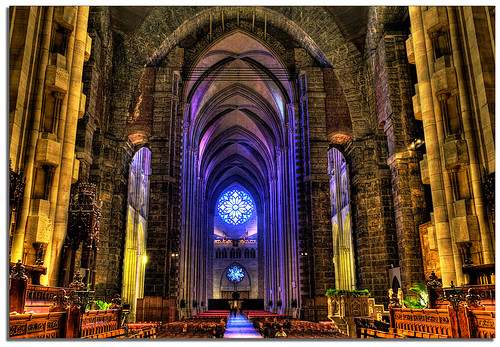
To help facilitate this kind of remembering you can do an exercise to wake up somehow ( whatever that means to you) or invoke presence every time you cross the threshold into a new space. An elaboration of this appears in E.J. Gold's Practical Work On Self chapter 15 called Doorways. You'll also find there an explanation related to the activation of new nervous systems through this exercise.
I'll leave it at there for now and get into music and new space next time.
Subscribe to:
Posts (Atom)