The practice of doing labyrinth readings can also heal. It basically provides the same type of service, a transmission of energy of some sort.
This energy has many different names and has been known for thousands of years in esoteric circles. More recently, Wilhelm Reich named it "orgone" and did extensive scientific research on the subject.
Sufis call it baraka, the Chinese know it as qigong. It may be the L.V.X. of Rosicrucians or the prana of the yogis. Every system or culture that has a name for this energy maintains that it's potentially available to anyone.
Wilhelm Reich also did groundbreaking work with using energy to heal.
The work of Wilhelm Reich is often referred to in the history and teaching of energy as a vehicle for healing.
Angels Healing Journey is a "Book of the Dead" by E. J. Gold with an orientation toward healing.
Angels Healing Journey is a book one may choose to use to address the Being of another just as you might do if you were to do a reading from one of the various "Books of the Dead". You would do this typically for someone who is suffering from one illness or another, though the book can and is used as a "Book of the Dead" since it contains readings for the First Stage (The Symptoms), Transition, Confronting the Clear Light, The Second Stage ( Disintegration) and the subsequent readings for the standard (number of) 49 Chambers for those in transition in the between lives states. An interesting feature of this book is the list of common diseases people suffer from, the names of their (corresponding) Angelic Healers, and the chamber(s) where they can be found. Turning to those chambers one can then read a description of these angelic entities and learn about some of their major attributes.
- James Duggan
It does use esoteric Hebrew imagery but apart from that has no connection to any religion, and again, functions effectively with or without limit of belief system. You don't have to believe any of it is real or that it works, but it helps. In that way it can be like magick where you temporarily suspend disbelief and skepticism to consciously, willfully, and voluntarily enter a belief system of your own design for your own intentions, and when done with that belief system, leave it.
Angel's Healing Journey uses the model/metaphor based on a tradition called Angelology. Peter Lamborn Wilson wrote a classic and beautiful work on the subject called Angels that first appeared in 1980.
I find it helpful when working with metaphors outside the ordinary programming and consensus of what is "real", to remember this brilliant bit of advice:
"In this book it is spoken of the Sephiroth and the Paths; of Spirits and Conjurations; of Gods, Spheres, Planes, and many other things which may or may not exist. It is immaterial whether these exist or not. By doing certain things certain results will follow; students are most earnestly warned against attributing objective reality or philosophic validity to any of them."
— Aleister Crowley (Magick in Theory and Practice)
It seems that this kind of healing isn't necessarily about curing diseases or making the body live longer. The healing takes place on an essential level which may or may not help the body.
Thursday, July 28, 2011

Monday, July 25, 2011
Without Any Limit of Belief System
Special thanks to all my critics who show me how they continue to fail to get it, to receive what I'm communicating. So I'm going to get a little remedial here.
The previous post, "Bardo Readings", had nothing to do, and is not connected with any Organized or Unorganized Religion whatsoever. I know what you're going to say, that this was EXPLICITLY STATED in the post:
The reading instructions very clearly outline when and what to read, without any limitation of belief system--the practice is presented as non-denominational, not requiring Buddhist or Christian or Jewish prayers, but also not in conflict with any of these.
The part where it says, " without any limit of belief system" means that no particular belief system is required, at all, at all. You don't even have to believe that the readings are doing anything for dead people, but if you are reading, the existential fact is that you are reading at least for yourself and so could stumble upon something of value like you might with any other book.
Since this seems quite clear, I figured that the comparison to the Catholic Church could have come from an automatic, mechanical, Pavlovian reaction to how I signed off - the word "Blessings" is used by Christians ... as well as Pagans. At least I know the critics hang on my every word.
The post also had no intention of indoctrination into any strange cult or philosophical ideology. My philosophy holds that everyone has the liberty and right to choose for themselves what to do with their life in the spirit of Crowley's "Do what thou wilt." Or like Joseph Campbell's, "follow your bliss," or Timothy Leary's exhortation for everyone to "start your own religion" - uh oh, there's that word again, religion. Sorry if it freaks anyone out. Leary meant something like making your daily life sacred in however you as an individual choose to do so.
I only intended to present and suggest methods for dealing with/coping with death because I personally experienced a great deal of death at the time of the post. I've been working in this area since about 1980 when I randomly opened to it in Carl Jung's Collected Works. I've picked up a few things along the way and felt it necessary to pass some of it along yesterday.
To review, these methods include:
- learning how to do formal readings from The American Book of the Dead
- reading from any inspired text that feels right
- practicing Magick which can involve learning Qabalah. Mysticism appears identical to Theurgic Magick, so meditative activities could work as a method of bardo service.
- listening/ playing music with a particular intention or focus.
- writing
Intellectuals and cynics who take this as a bunch of nonsense have my permission to maintain their status quo and continue to tell lies about something they lack any understanding of. This is for a few people who might be interested.
There is no way I can prove any of this works. The only way to find out is to try it. At first, it might take a little time before you feel a strong contact with the bardo. However, you'll sense pretty quickly what effect practicing any of these methods has on you.
I also advocate the Gurdjieffian advice: DO NOT BELIEVE ANYTHING I SAY. Verify everything for yourself.
The previous post, "Bardo Readings", had nothing to do, and is not connected with any Organized or Unorganized Religion whatsoever. I know what you're going to say, that this was EXPLICITLY STATED in the post:
The reading instructions very clearly outline when and what to read, without any limitation of belief system--the practice is presented as non-denominational, not requiring Buddhist or Christian or Jewish prayers, but also not in conflict with any of these.
The part where it says, " without any limit of belief system" means that no particular belief system is required, at all, at all. You don't even have to believe that the readings are doing anything for dead people, but if you are reading, the existential fact is that you are reading at least for yourself and so could stumble upon something of value like you might with any other book.
Since this seems quite clear, I figured that the comparison to the Catholic Church could have come from an automatic, mechanical, Pavlovian reaction to how I signed off - the word "Blessings" is used by Christians ... as well as Pagans. At least I know the critics hang on my every word.
The post also had no intention of indoctrination into any strange cult or philosophical ideology. My philosophy holds that everyone has the liberty and right to choose for themselves what to do with their life in the spirit of Crowley's "Do what thou wilt." Or like Joseph Campbell's, "follow your bliss," or Timothy Leary's exhortation for everyone to "start your own religion" - uh oh, there's that word again, religion. Sorry if it freaks anyone out. Leary meant something like making your daily life sacred in however you as an individual choose to do so.
I only intended to present and suggest methods for dealing with/coping with death because I personally experienced a great deal of death at the time of the post. I've been working in this area since about 1980 when I randomly opened to it in Carl Jung's Collected Works. I've picked up a few things along the way and felt it necessary to pass some of it along yesterday.
To review, these methods include:
- learning how to do formal readings from The American Book of the Dead
- reading from any inspired text that feels right
- practicing Magick which can involve learning Qabalah. Mysticism appears identical to Theurgic Magick, so meditative activities could work as a method of bardo service.
- listening/ playing music with a particular intention or focus.
- writing
Intellectuals and cynics who take this as a bunch of nonsense have my permission to maintain their status quo and continue to tell lies about something they lack any understanding of. This is for a few people who might be interested.
There is no way I can prove any of this works. The only way to find out is to try it. At first, it might take a little time before you feel a strong contact with the bardo. However, you'll sense pretty quickly what effect practicing any of these methods has on you.
I also advocate the Gurdjieffian advice: DO NOT BELIEVE ANYTHING I SAY. Verify everything for yourself.
Saturday, July 23, 2011
Bardo Readings
Received Jerry Cornelius' new book Altheia yesterday. First sentence evokes the Bardo. It reads:
"How the mind can torture itself in its quest to understand the travels of the soul from life, through death, to life again."
I find the timing of the book's release interesting as it coincides with my brief abstracts on the same subject that he begins with. I've just started the book. So far, it's first rate.
Saw that a new film called The Tree of Life opened in town today. I had heard about it a few weeks ago but had forgotten about it until now.
Nobody can tell you what will happen when you die. It's possible that the after-life bardo spaces, reported in so many different ways in many different cultures, occur as a result of the unraveling of the subconscious mind in the last minutes or seconds before brain-death.
Even taking the strictly scientific materialist perspective, that nothing happens after life, Bardo Training is of immense benefit. The way Erik Davis puts in Nomad Codes:
"Early in Waking Life, Ethan Hawke quotes Timothy Leary to the effect that, even if nothing of us survives death, the last few minutes of the brain's electrical activity may be experienced by the dying person as an entire life racing in time-lapse -- or, as the film itself suggests, a nearly infinite labyrinth of dreams. From this perspective, the traditional teachings of bardo navigation may come in handy despite the reality of brain-death: even if we are only riding that last wave to flatline, it pays to know how to surf. "
They are referring to a film called Waking Life by Richard Linklater which I haven't yet seen.
So what are the traditional teachings of bardo navigation?
I would guess that it involves the practice of delivering readings shortly before and during the transition of death, and for a period of time afterwards. Of course, there are now many non-traditional methods that encourage bardo navigation, qabalah being one of them, but traditionally it seems that readings have been done in certain cultures, in particular the Tibetan, for hundreds or thousands of years.
One way to experience or at least get a sense of the bardo is by learning how to do the readings. Clear instructions are given in the American Book of the Dead (ABD).
Readings do not necessarily need to come from the ABD. Any text meaningful to you, and/or the Voyager(s) ie the spirit or "soul" of the person(s) recently deceased. "Readings" don't even have to take the form of reading aloud from a text. I wrote a short story once as a "reading." It seems that there are different ways or methods to transmit a particular "something" to a voyager that can help them. The nature of this "something" can, I believe, get discovered more rapidly through Qabalah.
However, since it is a method of Liberation by sound, the easiest way to begin, and be effective immediately, is to start with the ABD. From the editorial description:
This book has been and still remains an important tool for providing a spiritual service to a dying person as opposed to grieving, processing loss, or mourning for that person's passage. Front matter includes "Notes on the Labyrinth" (or the Bardo...) and other commentary by the author that provides insights for an American reader who wishes to provide this guiding service to a family member, spouse, friend, or anyone who is terminal. The reading instructions very clearly outline when and what to read, without any limitation of belief system--the practice is presented as non-denominational, not requiring Buddhist or Christian or Jewish prayers, but also not in conflict with any of these. A schedule of readings shows graphically how to carry out the full series of 49 days of readings, at approximately 10 to 20 minutes per reading.
There is a course available by correspondence and on the internet that gives additional training for readers who wish to pursue the practice of performing "Labyrinth Readings" or "Bardo guiding" as a service to others--beyond one's own family and personal network.
Sometimes music can act as a carrier wave for the readings. I know of a difficult and stubborn woman who had Irish ancestry in her background. Nothing seemed to reach her until traditional Irish music was played with the reading.
News comes of the sudden death of Amy Winehouse, a great loss to the music community. As Keith Richards sings:
It's another good-bye to another good friend...

Playing her music while directing good intentions, best wishes, or prayers ( ie NOT grief, sadness, despair anger, etc) might serve a function similar to doing a reading.
This is the 93rd post of this blog.
Blessings and Peace ...
"How the mind can torture itself in its quest to understand the travels of the soul from life, through death, to life again."
I find the timing of the book's release interesting as it coincides with my brief abstracts on the same subject that he begins with. I've just started the book. So far, it's first rate.
Saw that a new film called The Tree of Life opened in town today. I had heard about it a few weeks ago but had forgotten about it until now.
Nobody can tell you what will happen when you die. It's possible that the after-life bardo spaces, reported in so many different ways in many different cultures, occur as a result of the unraveling of the subconscious mind in the last minutes or seconds before brain-death.
Even taking the strictly scientific materialist perspective, that nothing happens after life, Bardo Training is of immense benefit. The way Erik Davis puts in Nomad Codes:
"Early in Waking Life, Ethan Hawke quotes Timothy Leary to the effect that, even if nothing of us survives death, the last few minutes of the brain's electrical activity may be experienced by the dying person as an entire life racing in time-lapse -- or, as the film itself suggests, a nearly infinite labyrinth of dreams. From this perspective, the traditional teachings of bardo navigation may come in handy despite the reality of brain-death: even if we are only riding that last wave to flatline, it pays to know how to surf. "
They are referring to a film called Waking Life by Richard Linklater which I haven't yet seen.
So what are the traditional teachings of bardo navigation?
I would guess that it involves the practice of delivering readings shortly before and during the transition of death, and for a period of time afterwards. Of course, there are now many non-traditional methods that encourage bardo navigation, qabalah being one of them, but traditionally it seems that readings have been done in certain cultures, in particular the Tibetan, for hundreds or thousands of years.
One way to experience or at least get a sense of the bardo is by learning how to do the readings. Clear instructions are given in the American Book of the Dead (ABD).
Readings do not necessarily need to come from the ABD. Any text meaningful to you, and/or the Voyager(s) ie the spirit or "soul" of the person(s) recently deceased. "Readings" don't even have to take the form of reading aloud from a text. I wrote a short story once as a "reading." It seems that there are different ways or methods to transmit a particular "something" to a voyager that can help them. The nature of this "something" can, I believe, get discovered more rapidly through Qabalah.
However, since it is a method of Liberation by sound, the easiest way to begin, and be effective immediately, is to start with the ABD. From the editorial description:
This book has been and still remains an important tool for providing a spiritual service to a dying person as opposed to grieving, processing loss, or mourning for that person's passage. Front matter includes "Notes on the Labyrinth" (or the Bardo...) and other commentary by the author that provides insights for an American reader who wishes to provide this guiding service to a family member, spouse, friend, or anyone who is terminal. The reading instructions very clearly outline when and what to read, without any limitation of belief system--the practice is presented as non-denominational, not requiring Buddhist or Christian or Jewish prayers, but also not in conflict with any of these. A schedule of readings shows graphically how to carry out the full series of 49 days of readings, at approximately 10 to 20 minutes per reading.
There is a course available by correspondence and on the internet that gives additional training for readers who wish to pursue the practice of performing "Labyrinth Readings" or "Bardo guiding" as a service to others--beyond one's own family and personal network.
Sometimes music can act as a carrier wave for the readings. I know of a difficult and stubborn woman who had Irish ancestry in her background. Nothing seemed to reach her until traditional Irish music was played with the reading.
News comes of the sudden death of Amy Winehouse, a great loss to the music community. As Keith Richards sings:
It's another good-bye to another good friend...
Playing her music while directing good intentions, best wishes, or prayers ( ie NOT grief, sadness, despair anger, etc) might serve a function similar to doing a reading.
This is the 93rd post of this blog.
Blessings and Peace ...
Tuesday, July 19, 2011
Hitchikers Guide and Finnegans Wake
To clarify a remark from the last post:
Because Bardo Training is synonymous with Magick, it does not follow that all Magick works as Bardo Training.
Speaking very generally, Magick can get classified into two branches:
1. Thaumaturgy, which has to do with changing the environment in some way, ie creating favorable weather for the crops, casting spells to influence things, cursing people who upset you, etc.
I would have to say that some measure of this kind of magick I've seen attempted has been by amateur dabblers thoroughly caught up in superstition and fantasy. Most of these types lack any real magical juice. I do acknowledge and have met rare individuals who can actually use Thaumaturgy in a responsible and non-ego gratifying way. Even so, it seems usually used quite sparingly.
2. Theurgic, that type of Magick concerned with expanding consciousness; invoking and contacting "god-forms" to open up circuits of gnostic reception; the Knowledge and Conversation of the Holy Guardian Angel, which, in one sense, basically means finding out what in the hell you're here to do (True Will) and doing it., etc.
Theurgic Magick has significantly greater likelihood of providing the benefit of Bardo Training than thaumaturgy.
To address a recent case brought to my attention: If someone imagines they are putting a curse on you, a couple of courses of action come to mind:
1. You can just ignore it. Nothing will happen, it's just fantasy and superstition on their part. They might have even dreamed up of engaging in some kind of war with you for some imaginary reason - most likely unknown to you, but probably having to do with an inadvertent slight of one kind or another.
2. You can somehow metaphorically, and compassionately, position a mirror in front of them in the hopes that they will get a glimpse of the pain that's causing such fantastic daydreams. Anyone who suggests permanently hurting someone because they expressed a view that offended them is obviously in a great deal of pain however deeply buried it may be. Robert Anton Wilson somewhere recommends Laura Huxley's book of basic magick exercises called "You Are Not the Target." The exercise that's also the title of the book further explores this.
Ironically, having a curse thrown in your direction, if one should be so lucky, can be great for Bardo Training:
A string of meditations called "type three" meditations are the performing meditations - in other words, how to do something you wish to do while conflicting realities and disorientating phenomena are running on.
- American Book of the Dead, p.41
The curser actually serves the cursee.
Hitchikers Guide to the Galaxy
Another qabalah encoded "book of the dead" type of literature is the science fiction comedy classic, The Hitchiker's Guide to the Galaxy by Douglas Adams. The main character, Arthur Dent gets off of Earth just before it gets destroyed to make way for a Hyperspatial Bypass Express. Dent, in his adventures post-Earth-mortem, travels through a series of bardo-like spaces and adventures learning as he goes. Very early on, after his first jump off of Earth, he is told by his extra-terrestrial guide, Ford Prefect, to always travel with a towel. Sound bardo advice on a few different levels.

Zaphod Beeblebrox, President of the Universe
The Hitchiker's Guide books are good as are the radio recordings. I've always enjoyed the BBC television production of this story. The Hollywood film version changed a lot and dumbed it down into a science fiction soap opera, a predictably superficial melodrama. Not worth seeing, in my opinion.
Immediately after the conclusion of the series, at the very end of the last episode, a song is played over the end credits - not only is it incredibly uplifting but also a crystal clear communication of the Great Work. I won't say what the song is. I think the whole series must be seen for the full effect of the music.
Finnegans Wake
Finnegans Wake counts as one of the greatest literary storehouses of qabalah enriched bardo data. It's admittedly a difficult read, at first, but like any other maze, gets easier after a while through practice. One trick to navigating the foreignness of all the coined words, phrases and mash-ups, is to sound out the words phonetically. You can let the sound be a guide, as it works like any other book of the dead. James Joyce wrote musically.
from p. 18. I will give some explanation:
(Stoop) if you are abcedminded, to this claybook, what curios
of signs (please stoop), in this allaphbed! Can you rede (since
We and Thou had it out already) its world? It is the same told
of all. Many. Miscegenations on miscegenations. Tieckle. They
lived und laughed ant loved end left. Forsin. Thy thingdome is
given to the Meades and Porsons. The meandertale, aloss and
again, of our old Heidenburgh in the days when Head-in-Clouds
walked the earth. In the ignorance that implies impression that
knits knowledge that finds the nameform that whets the wits that
convey contacts that sweeten sensation that drives desire that
adheres to attachment that dogs death that bitches birth that
entails the ensuance of existentiality.
My interpretation: On one level he's asking the reader if they can read his Qabalah- can you read it's world?
"abcedminded" - a pun referring both to awareness of letters and to "absent-minded," perhaps in the sense of quieting the thinking brain chatter, as a condition for reading "its world."
"Miscegenations on miscegenations" - miscegenation means interbreeding and could indicate the cross-pollination,indexing, and referencing of various religions, mythologies, systems of knowledge, etc that occurs in Qabalah.
"It is the same told of all" - finding the common core of truth in each system.
" ant loved" - animals, real and imaginary, and insects have qabalistic connotations. Ants aren't on the animal chart in 777, but they suggests an obvious image. Perhaps the actual versus potential capacity of what qabalah develops.
"in the days when Head-In-Clouds walked the earth." - recalls a comment I made toward the end of the Tales of the Tribe class responding to someone who suggested the aim of Qabalah was to get one's consciousness to Kether. I replied, that the aim, as far as I was concerned, was to bring the awareness of Kether into Malkuth ( the material world) .
The last sentence that starts, "In the ignorance..." could describe a qabalistic process of theurgic magick from inception to manifestation. It also references the death/rebirth archetype.
Because Bardo Training is synonymous with Magick, it does not follow that all Magick works as Bardo Training.
Speaking very generally, Magick can get classified into two branches:
1. Thaumaturgy, which has to do with changing the environment in some way, ie creating favorable weather for the crops, casting spells to influence things, cursing people who upset you, etc.
I would have to say that some measure of this kind of magick I've seen attempted has been by amateur dabblers thoroughly caught up in superstition and fantasy. Most of these types lack any real magical juice. I do acknowledge and have met rare individuals who can actually use Thaumaturgy in a responsible and non-ego gratifying way. Even so, it seems usually used quite sparingly.
2. Theurgic, that type of Magick concerned with expanding consciousness; invoking and contacting "god-forms" to open up circuits of gnostic reception; the Knowledge and Conversation of the Holy Guardian Angel, which, in one sense, basically means finding out what in the hell you're here to do (True Will) and doing it., etc.
Theurgic Magick has significantly greater likelihood of providing the benefit of Bardo Training than thaumaturgy.
To address a recent case brought to my attention: If someone imagines they are putting a curse on you, a couple of courses of action come to mind:
1. You can just ignore it. Nothing will happen, it's just fantasy and superstition on their part. They might have even dreamed up of engaging in some kind of war with you for some imaginary reason - most likely unknown to you, but probably having to do with an inadvertent slight of one kind or another.
2. You can somehow metaphorically, and compassionately, position a mirror in front of them in the hopes that they will get a glimpse of the pain that's causing such fantastic daydreams. Anyone who suggests permanently hurting someone because they expressed a view that offended them is obviously in a great deal of pain however deeply buried it may be. Robert Anton Wilson somewhere recommends Laura Huxley's book of basic magick exercises called "You Are Not the Target." The exercise that's also the title of the book further explores this.
Ironically, having a curse thrown in your direction, if one should be so lucky, can be great for Bardo Training:
A string of meditations called "type three" meditations are the performing meditations - in other words, how to do something you wish to do while conflicting realities and disorientating phenomena are running on.
- American Book of the Dead, p.41
The curser actually serves the cursee.
Hitchikers Guide to the Galaxy
Another qabalah encoded "book of the dead" type of literature is the science fiction comedy classic, The Hitchiker's Guide to the Galaxy by Douglas Adams. The main character, Arthur Dent gets off of Earth just before it gets destroyed to make way for a Hyperspatial Bypass Express. Dent, in his adventures post-Earth-mortem, travels through a series of bardo-like spaces and adventures learning as he goes. Very early on, after his first jump off of Earth, he is told by his extra-terrestrial guide, Ford Prefect, to always travel with a towel. Sound bardo advice on a few different levels.
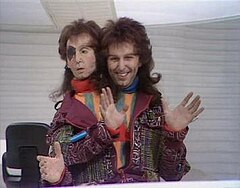
Zaphod Beeblebrox, President of the Universe
The Hitchiker's Guide books are good as are the radio recordings. I've always enjoyed the BBC television production of this story. The Hollywood film version changed a lot and dumbed it down into a science fiction soap opera, a predictably superficial melodrama. Not worth seeing, in my opinion.
Immediately after the conclusion of the series, at the very end of the last episode, a song is played over the end credits - not only is it incredibly uplifting but also a crystal clear communication of the Great Work. I won't say what the song is. I think the whole series must be seen for the full effect of the music.
Finnegans Wake
Finnegans Wake counts as one of the greatest literary storehouses of qabalah enriched bardo data. It's admittedly a difficult read, at first, but like any other maze, gets easier after a while through practice. One trick to navigating the foreignness of all the coined words, phrases and mash-ups, is to sound out the words phonetically. You can let the sound be a guide, as it works like any other book of the dead. James Joyce wrote musically.
from p. 18. I will give some explanation:
(Stoop) if you are abcedminded, to this claybook, what curios
of signs (please stoop), in this allaphbed! Can you rede (since
We and Thou had it out already) its world? It is the same told
of all. Many. Miscegenations on miscegenations. Tieckle. They
lived und laughed ant loved end left. Forsin. Thy thingdome is
given to the Meades and Porsons. The meandertale, aloss and
again, of our old Heidenburgh in the days when Head-in-Clouds
walked the earth. In the ignorance that implies impression that
knits knowledge that finds the nameform that whets the wits that
convey contacts that sweeten sensation that drives desire that
adheres to attachment that dogs death that bitches birth that
entails the ensuance of existentiality.
My interpretation: On one level he's asking the reader if they can read his Qabalah- can you read it's world?
"abcedminded" - a pun referring both to awareness of letters and to "absent-minded," perhaps in the sense of quieting the thinking brain chatter, as a condition for reading "its world."
"Miscegenations on miscegenations" - miscegenation means interbreeding and could indicate the cross-pollination,indexing, and referencing of various religions, mythologies, systems of knowledge, etc that occurs in Qabalah.
"It is the same told of all" - finding the common core of truth in each system.
" ant loved" - animals, real and imaginary, and insects have qabalistic connotations. Ants aren't on the animal chart in 777, but they suggests an obvious image. Perhaps the actual versus potential capacity of what qabalah develops.
"in the days when Head-In-Clouds walked the earth." - recalls a comment I made toward the end of the Tales of the Tribe class responding to someone who suggested the aim of Qabalah was to get one's consciousness to Kether. I replied, that the aim, as far as I was concerned, was to bring the awareness of Kether into Malkuth ( the material world) .
The last sentence that starts, "In the ignorance..." could describe a qabalistic process of theurgic magick from inception to manifestation. It also references the death/rebirth archetype.
Monday, July 18, 2011
A Fairy Tale for Paranoids
Robert Anton Wilson and/or Robert Shea have a qabalistic look at Death in The Illuminatus! Trilogy but first I feel it prudent to give the disclaimer found on the back cover of my copy:
"A fairy tale for paranoids."
- Epicene Wildblood
- Epicene Wildblood
these excerpts, demonstrating a cynical and twisted view are from p. 680 - 682. The character Drake is getting a Tarot card reading:
"That isn't what you see," Drake said. "And it isn't what I see. The Devil and the Tower together are a pretty destructive pair, aren't they? "
"I suppose you know what the Lovers reversed means, too?" she asked.
"'The Answer of the Oracle Is Always Death.'" he quoted.
"But you won't accept it."
" The only way to conquer Death -- until science provides an immortality pill -- is to make him your servant, your company cop," Drake said calmly. "That's the key I've been looking for. The bartender never becomes an alchoholic, and the high priest laughs at the gods. Besides, the Tower is rotten to the core and deserves to be destroyed." He pointed abruptly to the Fool ...
"... You will make Death your servant as a tactic to master him. Yours is, indeed, the left-hand path. You will cause immense suffering -- especially to yourself at first. But after a while you won't notice that; after a while you won't even notice the horror you inflict on others. Men will say that you are a materialist, a worshipper of money.
What do you hate most?" she asked abruptly.
"Sentimental slop and lies. All the Christian lies in Sunday school, all the democratic lies in the newspapers, all the socialist lies our so-called intellectuals are spouting these days. Every rotten, crooked, sneaking, hypocritical deception people use to hide from themselves that we're all still hunting animals in a jungle.." ...
... "Go on" Drake was unsmiling but undisturbed.
"The King of Swords and the King of Wands are both very active. You could do all this harmlessly, by becoming an artist and showing this vision of the jungle. You don't have to create it literally and inflict it on your fellow humans."
Drake rejects the advice and retreats back into cynicism.
"That isn't what you see," Drake said. "And it isn't what I see. The Devil and the Tower together are a pretty destructive pair, aren't they? "
"I suppose you know what the Lovers reversed means, too?" she asked.
"'The Answer of the Oracle Is Always Death.'" he quoted.
"But you won't accept it."
" The only way to conquer Death -- until science provides an immortality pill -- is to make him your servant, your company cop," Drake said calmly. "That's the key I've been looking for. The bartender never becomes an alchoholic, and the high priest laughs at the gods. Besides, the Tower is rotten to the core and deserves to be destroyed." He pointed abruptly to the Fool ...
"... You will make Death your servant as a tactic to master him. Yours is, indeed, the left-hand path. You will cause immense suffering -- especially to yourself at first. But after a while you won't notice that; after a while you won't even notice the horror you inflict on others. Men will say that you are a materialist, a worshipper of money.
What do you hate most?" she asked abruptly.
"Sentimental slop and lies. All the Christian lies in Sunday school, all the democratic lies in the newspapers, all the socialist lies our so-called intellectuals are spouting these days. Every rotten, crooked, sneaking, hypocritical deception people use to hide from themselves that we're all still hunting animals in a jungle.." ...
... "Go on" Drake was unsmiling but undisturbed.
"The King of Swords and the King of Wands are both very active. You could do all this harmlessly, by becoming an artist and showing this vision of the jungle. You don't have to create it literally and inflict it on your fellow humans."
Drake rejects the advice and retreats back into cynicism.
Saturday, July 16, 2011
Qabalah and the Bardo
"People don't believe me when I say this to them ... what I'm trying to do with my music is conquer Death. " - Ornette Coleman in a private conversation at his apartment. I'm actually one of the few people that this makes sense to.
Listening to Coleman's music, Free Jazz, Science Fiction, Skies of America, and much else describes one way of gaining an appreciation and aptitude for navigating unfamiliar territory and new spaces, skills essential and invaluable for surviving in the bardo, for conquering death. Coleman formed his musical approach and explorations into a system which he called Harmolodics. The idea of harmony corresponds with Tiphareth.

Using music as a doorway for the exploration of new spaces has points of similarity with using the connecting pathways on the Tree of Life as meditational focal points, doorways into different worlds of perception. Sometimes called "Pathworkings," this also works by using Tarot Cards as focal points/doorways into alternate realities, different chambers of cognition.
Keith Richard's comments on songwriting from his book Life seem very related to the qabalistic approach I'm suggesting. Though a much different kind of music than Coleman's free jazz experiments, the essential nature of his songs as he describes it appears very connected to surviving in the bardo:
That's the great thing about songwriting, its not an intellectual experience. One might have to apply the brain here and there, but basically, it's capturing the moment.
What is it that makes you want to write songs? In a way, you want to stretch yourself into other people's hearts. You want to plant yourself there, or at least get a resonance. Where other people become a bigger instrument than the one you're playing. It becomes almost an obsession to touch other people. To write a song that is remembered and taken to heart is a connection, a touching of bases, a thread that runs through all of us. A stab to the heart. Sometimes I think songwriting is about tightening the heart strings as much as possible without bringing on a heart attack.
There are several ways Qabalah can be useful for the purpose of bardo training. Awareness of Qabalah enables one to become "maze bright." Learning to move about and function in the bardo seems like learning to solve a maze, making your way through a labyrinth. Functioning well in life to the point of having the liberty and will to carry out your life's work also seems like navigating a labyrinth. Learning to solve mazes and puzzles implants and encourages skills for negotiating more difficult labyrinths.
Bardo training is not only preparation for Death, it also results in a dramatically increased quality, perception, and experience of Life. To "die" before you die, a Sufi strategy, makes this apparent.
Bardo training appears synonymous Magick: the Science and Art of causing change to occur in accordance with Will. Many of Crowley's exercises and experiments clearly and obviously constitute bardo training of one kind or another. I say obvious meaning that it doesn't need qabalistic decoding to see this, although it will greatly help. I'll expand on this later.
The death/rebirth archetype describes a classic method for causing change to occur. You "die" to old habits or behavior, reprogram yourself in the bardo - that space in-between "death" and "rebirth" - and take "rebirth" (if all goes well) along the lines of whatever aim has been set.
Of course, this isn't as easy as it sounds. Sometimes repeated efforts need doing over a length of time to bring about permanent change. Elaboration and demonstration of this technique appears in Cosmic Trigger Volume I, by Robert Anton Wilson.
The most explicit and detailed information regarding this process is in the American Book of the Dead and related works by E.J. Gold. Here he mentions Qabalah in connection with rebirth.
As the components of consciousness reform, one seems to experience rebirth, although in fact it is not re-entry into the world, but a new construct-reality which is taking place. Once crystallized, the newly formed consciousness cannot be altered except by a breakdown process such as voyaging in the macrodimensional domains of the labyrinth. Sometimes the reformed consciousness is even more securely programmed than the previous one, and the ego is strengthened rather than broken.
This continuous process of subjective change is the only change there is. A good subjective notation of subjective consciousness alteration is the I-Ching. Another of these "living" notebooks of plasma configuration is the Kabbalah. The 99 Names of God, Mudra, Yantra, Prime-Time Programming, and the Lesser Key of Solomon are further examples of change-notations in the reality spectrum.
p. 45, American Book of the Dead.
Furthermore, regarding rebirth:
The idea of getting into rebirth in an undesirable or miserable lower dimension is the cause of this desperation to find a safe space in which to hide. If I don't panic, I won't get rebirth in a lower dimension.
On the other hand if I become desperate, I may try to squeeze in between some rocks or buildings, and in fact none of the safe spaces I'm seeing are actually as they appear to be. Those are wombs in various dimensions. They're color-coded; I can look carefully at their color and I'll be able to tell which dimension I'm being attracted to.
p. 146, American Book of the Dead., Twenty-Fourth Chamber.
Perhaps womb door openings are coded in other ways, too?
Listening to Coleman's music, Free Jazz, Science Fiction, Skies of America, and much else describes one way of gaining an appreciation and aptitude for navigating unfamiliar territory and new spaces, skills essential and invaluable for surviving in the bardo, for conquering death. Coleman formed his musical approach and explorations into a system which he called Harmolodics. The idea of harmony corresponds with Tiphareth.

Using music as a doorway for the exploration of new spaces has points of similarity with using the connecting pathways on the Tree of Life as meditational focal points, doorways into different worlds of perception. Sometimes called "Pathworkings," this also works by using Tarot Cards as focal points/doorways into alternate realities, different chambers of cognition.
Keith Richard's comments on songwriting from his book Life seem very related to the qabalistic approach I'm suggesting. Though a much different kind of music than Coleman's free jazz experiments, the essential nature of his songs as he describes it appears very connected to surviving in the bardo:
That's the great thing about songwriting, its not an intellectual experience. One might have to apply the brain here and there, but basically, it's capturing the moment.
What is it that makes you want to write songs? In a way, you want to stretch yourself into other people's hearts. You want to plant yourself there, or at least get a resonance. Where other people become a bigger instrument than the one you're playing. It becomes almost an obsession to touch other people. To write a song that is remembered and taken to heart is a connection, a touching of bases, a thread that runs through all of us. A stab to the heart. Sometimes I think songwriting is about tightening the heart strings as much as possible without bringing on a heart attack.
There are several ways Qabalah can be useful for the purpose of bardo training. Awareness of Qabalah enables one to become "maze bright." Learning to move about and function in the bardo seems like learning to solve a maze, making your way through a labyrinth. Functioning well in life to the point of having the liberty and will to carry out your life's work also seems like navigating a labyrinth. Learning to solve mazes and puzzles implants and encourages skills for negotiating more difficult labyrinths.
Bardo training is not only preparation for Death, it also results in a dramatically increased quality, perception, and experience of Life. To "die" before you die, a Sufi strategy, makes this apparent.
Bardo training appears synonymous Magick: the Science and Art of causing change to occur in accordance with Will. Many of Crowley's exercises and experiments clearly and obviously constitute bardo training of one kind or another. I say obvious meaning that it doesn't need qabalistic decoding to see this, although it will greatly help. I'll expand on this later.
The death/rebirth archetype describes a classic method for causing change to occur. You "die" to old habits or behavior, reprogram yourself in the bardo - that space in-between "death" and "rebirth" - and take "rebirth" (if all goes well) along the lines of whatever aim has been set.
Of course, this isn't as easy as it sounds. Sometimes repeated efforts need doing over a length of time to bring about permanent change. Elaboration and demonstration of this technique appears in Cosmic Trigger Volume I, by Robert Anton Wilson.
The most explicit and detailed information regarding this process is in the American Book of the Dead and related works by E.J. Gold. Here he mentions Qabalah in connection with rebirth.
As the components of consciousness reform, one seems to experience rebirth, although in fact it is not re-entry into the world, but a new construct-reality which is taking place. Once crystallized, the newly formed consciousness cannot be altered except by a breakdown process such as voyaging in the macrodimensional domains of the labyrinth. Sometimes the reformed consciousness is even more securely programmed than the previous one, and the ego is strengthened rather than broken.
This continuous process of subjective change is the only change there is. A good subjective notation of subjective consciousness alteration is the I-Ching. Another of these "living" notebooks of plasma configuration is the Kabbalah. The 99 Names of God, Mudra, Yantra, Prime-Time Programming, and the Lesser Key of Solomon are further examples of change-notations in the reality spectrum.
p. 45, American Book of the Dead.
Furthermore, regarding rebirth:
The idea of getting into rebirth in an undesirable or miserable lower dimension is the cause of this desperation to find a safe space in which to hide. If I don't panic, I won't get rebirth in a lower dimension.
On the other hand if I become desperate, I may try to squeeze in between some rocks or buildings, and in fact none of the safe spaces I'm seeing are actually as they appear to be. Those are wombs in various dimensions. They're color-coded; I can look carefully at their color and I'll be able to tell which dimension I'm being attracted to.
p. 146, American Book of the Dead., Twenty-Fourth Chamber.
Perhaps womb door openings are coded in other ways, too?
Thursday, July 14, 2011
Other Methods
The magical basis for the relevance of the "68" ideogram mentioned last post appears in one of Crowley's more important works: The Paris Working.
The Paris Working saw Crowley working with his main student at the time, Victor Neuberg
in a series of magical operations to contact and receive Higher Intelligence of a particular kind.
To give a flavor of this experiment:

The initials O.S.V. and L. T. stand for their magical mottos. The data forming the basis for the "68" meme:
O.S.V.: I haven't got that.... I want to lie here, and see Mercury. It seems that Hermes is my particular deity at present. The golden sparks of which the Universe is composed, are shot with silver lightnings. In his next aspect he should reveal to us a great deal of the inner meaning of this particular Rite.
To continue the identification, compare Christ's descent into hell with the function of Hermes as guide of the Dead...
How it relates to 68 - Christ = Tiphareth = 6; Mercury = Hod = 8
Temurah
Temurah is permutation. Traditionally, it is an elaborate method involving rearranging lines and letters in the Bible described in detail in the Intro to Kaballah Unveiled. I only use its most basic form of rearranging letters or words and phrases to find different but cognate meanings.
The cut-up method of literary solve coagula popularized by Gysin and Burroughs describes a form of Temurah. David Bowie is one artist who has used this technique to invoke lyrics.
Through Temurah, all anagrams of a particular group of letters have equivalency - equal valence ie equal electrical charge - to one another.
For example, The initials of James Joyces' archetypal character from Finnegans Wake, Anna Livia Plurabelle, ALP can get rearranged as LAP, APL, or PLA. All of them add to 111, (A=1)+(L=30)+(P=80).
APL suggests apple by its sound so in our lexicon, the word "apple" used in some contexts refers to the same idea suggested by 111. I'll let anyone interested discover that idea on their own but here's a hint, Robert Anton Wilson references the same idea almost immediately in Illuminatus!
I discovered in Wilson's Tales of the Tribe class that this same idea signified a major theme of Finnegans Wake.
Assigning "apple" this place in our lexicon may shed light and give insight to various myths such as the so-called temptation in the Garden of Eden, and the Golden Apple of Kallisti.
Knowledge of Temurah gives the qabalistic key for unlocking the data found in the Marx Bros. film, Animal Crackers, in the scene when they discover the painting has been stolen.
Etymology
Etymology, the study of the origins of words, serves as an important qabalistic type tool. We try to be precise and knowledgeable with the language we use because of the awareness that language alters our perception of reality.
Take the word Shakti, for example, a word co-opted and banalized into a kind of vague goddess worship type of energy by some of the more credulous fanatics of the New Age movement.
Looked at etymologically:
The word Shakti comes from the root word-Shak, ableness. The complete word translates to force of ableness.
from Alchemical Sex by E. J. Gold, p. 181
This gives a much clearer picture.
A second good example of etymological analysis was recently given by Jerry Cornelius in the promotion of his new book Altheia:
Cornelius is one of my favorite post-Crowley Thelemic writers along with Lon Milo Duquette and Kenneth Grant.
This explanation for the title of the book is a main reason why I will purchase it.
Puns
Puns appear a method for communicating or viewing multiple levels of reality, and by extension information. It has been said that James Joyce tried to pack as many meanings as possible in words and phrases in Finnegans Wake.
Crowley often codes occult data in puns. We can go back and look at ch.68 from The Book of Lies and see some obvious puns. If we've begun to learn some of Crowley's lexicon we see the pun of the word "place" in the 2nd line because we noticed that in Ch. 57 he describes a magical formula (ie method of working) represented by "place."
In The Sufis by Idries Shah he says Sufi masters put 7 levels of meaning in their communications.
Of course, numbers can be puns too. When I remember a good example, I'll demonstrate this.
Time Release
Sometimes significant qabalistic information can get received but not understood for some time, perhaps years later. This is where the importance of keeping a diary comes in.
Soon I'll post the story of how I first received the Tree of Life image and how it took years for what it was communicating to me to get accepted.
The Paris Working saw Crowley working with his main student at the time, Victor Neuberg
in a series of magical operations to contact and receive Higher Intelligence of a particular kind.
To give a flavor of this experiment:
O.S.V.: The god has appeared to me in his character as a messenger, but as a robust adult, rather than a slim youth. He has the winged helmet and sandals, and bears a Caduceus of gold. (Frater L.T. confirms this description in every respect.)

O.S.V.: Hear the words which I bear through the ambient air. The Father of All hath girt Himself with a many-coloured robe; the Father of All hath spilt his seed on galaxy and globe. The formation of Nebulae is like the bursting of the seed pods of flowers. (These are not his words; but it is his meaning. I can't get his words at all.) What we call light he calls wind. Our highest spiritual experiences are what he calls light. That is why one gets the phenomenon of the Opalescent Universe, so to call it, in the Sacrament of the Ninth Degree.) (It is most important.... Never mind about that.) All this is the key to the meaning of the Latin invocation in the Vision of the Universal Mercury which I have never understood. (Memo; obtain a copy and confirm this) We shall shortly be given someone who will be of great help to us in our working.
The initials O.S.V. and L. T. stand for their magical mottos. The data forming the basis for the "68" meme:
O.S.V.: I haven't got that.... I want to lie here, and see Mercury. It seems that Hermes is my particular deity at present. The golden sparks of which the Universe is composed, are shot with silver lightnings. In his next aspect he should reveal to us a great deal of the inner meaning of this particular Rite.
In the beginning was the Word, the Logos, who is Mercury; and is therefore to be identified with Christ. Both are messengers; their birth-mysteries are similar; the pranks of their childhood are similar. In the Vision of the Universal Mercury, Hermes is seen descending upon the sea, which refers to Mary. The Crucifixion represents the Caduceus; the two thieves, the two serpents; the cliff in the Vision of the Universal Mercury is Golgotha; Maria is simply Maia with the solar R in her womb. The controversy about Christ between the Synoptics and John was really a contention between the priests of Bacchus, Sol, and Osiris, also, perhaps, of Adonis and Attis, on the one hand, and those of Hermes on the other, at that period when initiates all over the world found it necessary, owing to the growth of the Roman Empire and the opening up of means of communication, to replace conflicting Polytheisms by a synthetic Faith. (This is absolutely new to me, this conception of Christ as Mercury.) Some difficulty about the [....]<
To continue the identification, compare Christ's descent into hell with the function of Hermes as guide of the Dead...
How it relates to 68 - Christ = Tiphareth = 6; Mercury = Hod = 8
Temurah
Temurah is permutation. Traditionally, it is an elaborate method involving rearranging lines and letters in the Bible described in detail in the Intro to Kaballah Unveiled. I only use its most basic form of rearranging letters or words and phrases to find different but cognate meanings.
The cut-up method of literary solve coagula popularized by Gysin and Burroughs describes a form of Temurah. David Bowie is one artist who has used this technique to invoke lyrics.
Through Temurah, all anagrams of a particular group of letters have equivalency - equal valence ie equal electrical charge - to one another.
For example, The initials of James Joyces' archetypal character from Finnegans Wake, Anna Livia Plurabelle, ALP can get rearranged as LAP, APL, or PLA. All of them add to 111, (A=1)+(L=30)+(P=80).
APL suggests apple by its sound so in our lexicon, the word "apple" used in some contexts refers to the same idea suggested by 111. I'll let anyone interested discover that idea on their own but here's a hint, Robert Anton Wilson references the same idea almost immediately in Illuminatus!
I discovered in Wilson's Tales of the Tribe class that this same idea signified a major theme of Finnegans Wake.
Assigning "apple" this place in our lexicon may shed light and give insight to various myths such as the so-called temptation in the Garden of Eden, and the Golden Apple of Kallisti.
Knowledge of Temurah gives the qabalistic key for unlocking the data found in the Marx Bros. film, Animal Crackers, in the scene when they discover the painting has been stolen.
Etymology
Etymology, the study of the origins of words, serves as an important qabalistic type tool. We try to be precise and knowledgeable with the language we use because of the awareness that language alters our perception of reality.
Take the word Shakti, for example, a word co-opted and banalized into a kind of vague goddess worship type of energy by some of the more credulous fanatics of the New Age movement.
Looked at etymologically:
The word Shakti comes from the root word-Shak, ableness. The complete word translates to force of ableness.
from Alchemical Sex by E. J. Gold, p. 181
This gives a much clearer picture.
A second good example of etymological analysis was recently given by Jerry Cornelius in the promotion of his new book Altheia:
My book is named ALETHEIA (αληθεια) after the Greek Goddess of Truth; the daughter of Zeus. Etymologically Aletheia’s name is derived from the Greek word alethus which means “true” or “not concealing.” The name Aletheia signifies many things. For instance, the letter “A” when added in front of a Greek word as a prefix can denote “not” or "non" while the
next five letters of her name spell out Lethe (λήθη); Lethe being the name of the mythological River of Forgetfulness which the dead must pass before reincarnating. Greek scholars have always acknowledged that Aletheia is the Goddess who helps us undo the forgetfulness of Lethe; which is why her name is often translates simply as “remembering.” Cornelius is one of my favorite post-Crowley Thelemic writers along with Lon Milo Duquette and Kenneth Grant.
This explanation for the title of the book is a main reason why I will purchase it.
Puns
Puns appear a method for communicating or viewing multiple levels of reality, and by extension information. It has been said that James Joyce tried to pack as many meanings as possible in words and phrases in Finnegans Wake.
Crowley often codes occult data in puns. We can go back and look at ch.68 from The Book of Lies and see some obvious puns. If we've begun to learn some of Crowley's lexicon we see the pun of the word "place" in the 2nd line because we noticed that in Ch. 57 he describes a magical formula (ie method of working) represented by "place."
In The Sufis by Idries Shah he says Sufi masters put 7 levels of meaning in their communications.
Of course, numbers can be puns too. When I remember a good example, I'll demonstrate this.
Time Release
Sometimes significant qabalistic information can get received but not understood for some time, perhaps years later. This is where the importance of keeping a diary comes in.
Soon I'll post the story of how I first received the Tree of Life image and how it took years for what it was communicating to me to get accepted.
Subscribe to:
Posts (Atom)